
1924: the first provisional observatory in Telnice
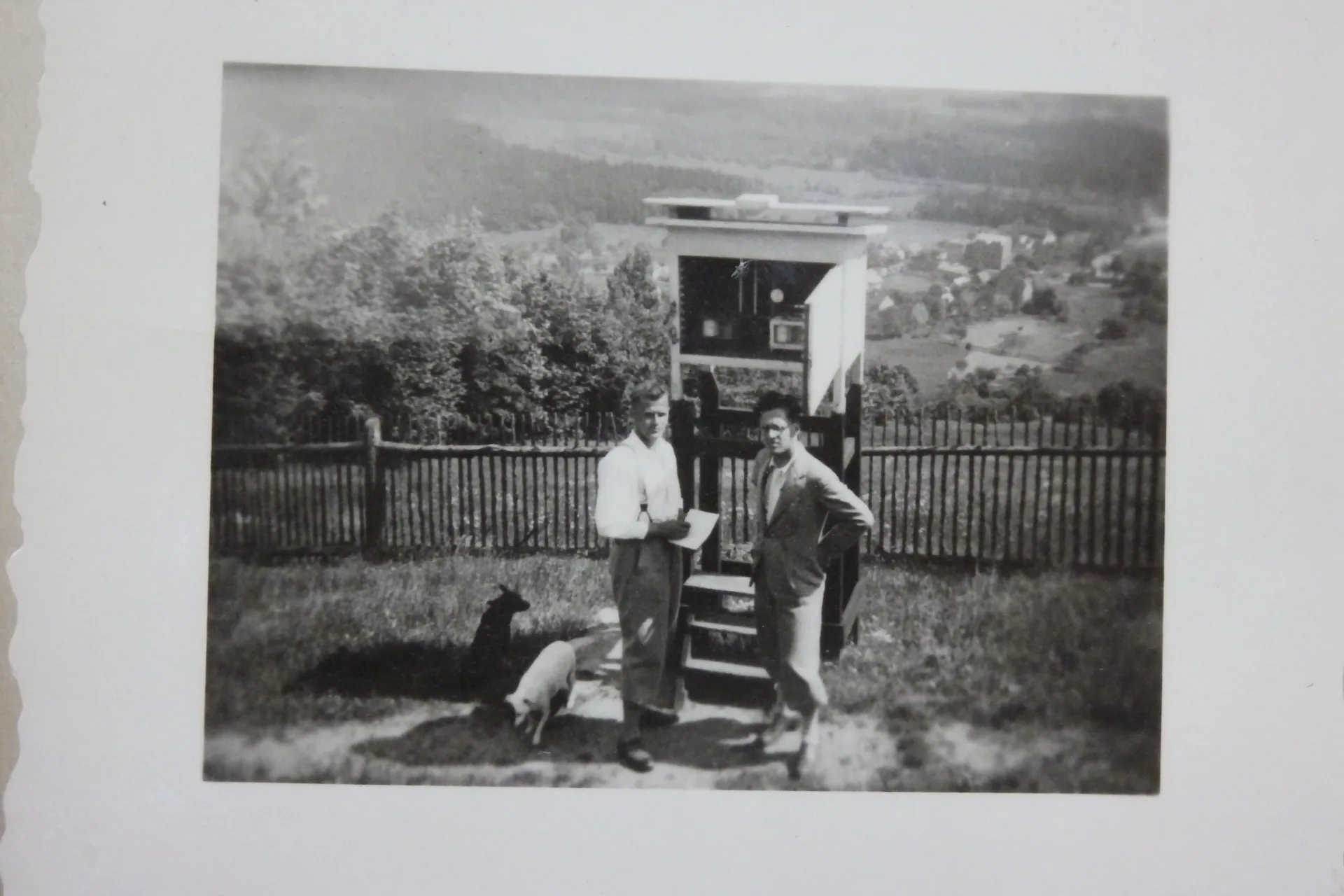
In mid-July 1924 a small subsidiary observation station of the German university observatory was established near Telnice. The Telnice memorial book describes it as a simple wooden house of the garden-shed type on the property of Ledebur estate, near the inn at the Green Tree and above the then Reich road.
The principal instrument was a six-inch refractor made by Steinheil of Munich, with an objective approximately 16 cm in diameter. A period local account claimed a magnification of 500–600× under favourable atmospheric conditions; the professional annual reports show that it was used mainly for stellar photometry. The equipment included instruments for measuring stellar brightness, particularly a Töpfer wedge photometer with an artificial star and a von Gothard recording device.
The observer was assistant Josef Mrázek. The program focused on the photometry of variable stars. The results were to be published in German university observatory publications and in Astronomische Nachrichten. The memoir explicitly states that meteorological observations have not yet been carried out in this initial station.
The reason for the transfer was the impossibility of obtaining accurate data in the centre of Prague: the period text names smoke, dust, urban noise and bright night sky. The Telnice site was not originally a public observatory but a scientific branch of the Prague University Institute.
1924–1926: the first scientific programme
The annual report published in 1927 summarises the first period of work. The Steinheil 6-inch refractor was observed with red and other variable stars: α Cassiopeiae, RR Arietis, ο Ceti, α Orionis, RS Cancri, Y Canum Venaticorum, X Hercules, g Herculis, α Hercules, R Lyrae, U Delphini, W Cygni, γ Cassiopeiae, β Pegasi, 10 Delphini, α Persei and μ Cephei. The report shall also indicate the number of individual observations; The largest files in this early period had α Cassiopeiae 54, R Lyrae 42 and γ Cassiopeiae 37 records.
On 8 February 1925 a partial phase of the lunar eclipse was observed.
Josef Mrázek also participated in experiments with abnormal sound propagation from artificial explosions. The observation point was on the ridge of the Ore Mountains. The annual report records attempts on 4 and 5 December 1924 from explosions at Jüterbog, 18 and 19 December 1924 from Gotha, 27-29 January 1925 from Paderborn, 25-27 February 1925 from Grafenwöhr, 9 and 23 October and 18 December 1925 again from Jüterbog and 26 June 1926 from Jüterbog. This was not a common astronomical observation, but a geophysical and atmospheric research using the favourable location of the Ore Mountains.
In 1926, the Institute acquired a large universal device of the Sartorius company with a diameter of 27 cm. He was located in Prague and served practical exercises in determining the geographical location; he belonged indirectly to the Liboňov station as part of the equipment and teaching of the mother institution.
1927: adverse weather and observation of the solar eclipse
The year 1927, according to the annual report, was extremely unfavourable to photometric observations. However, Josef Mrázek followed RR Arietis, α Cassiopeiae, γ Cassiopeiae, μ Cephei, ο Ceti, X Herculis, g Hercules, α Herculis, R Lyrae, α Orionis, β Pegasi and α Persei with a 6-inch Steinheil refractor.
In the eclipse of the Sun on June 29, 1927, it was only possible to capture its end because of the clouds. Planned photographic images and actinometric measurements could not take place. This detail shows that the station was not only seeking visual observation; It also envisaged photographic documentation and measuring the intensity of sunlight.
1928: more staff, a new lens, radio and meteor photography
At the end of 1927 Josef Mrázek was accepted as a permanent civil servant with the title of Commissioner of the Scientific Institute of the German University in Prague. Rudolf Tschilschke won the vacancy.
The Institute bought Voigtländer-Petzval lens with diameter 80 mm and focal length 280 mm, designed for installation on Steinheil's six-inch refractor. The Telefunken radio receiver for receiving time signals and the Original Odhner counter. The newly built library had 408 registered items.
Josef Mrázek continued to measure the red variables of the stars with the Steinheil refractor and the Töpfer wedge photometer. In addition to the traditional list of variables, ε Aurigae and β Pegasi were added, which were in doubt at the time.
In August 1928 an attempt was made to photograph the meteor shower Perseid simultaneously from Prague, Telnice and a private observatory in Mikulášovice. Each station used one camera. Only August 11 allowed the weather to expose seven plates according to the programme; The activity near the radiant was weak and all three stations had negative results. The attempt to observe Leonid in November was futile. Even unsuccessful measurements are important: they prove coordinated multistation photographic work.
At the same time, Josef Mrázek processed the older culmination observations of the moon and planets from 1910-1917, which were not reduced because of the war, and addressed the variable R Lyrae. Tschilschke was finishing his work on a two-star system of 70 Ophiuchi.
1929: formation of the association and construction of the stone observatory
In February 1929 the Association of Friends of the Observatory of the German University of Prague was established. Its role was to ensure the scientific activity of the Institute and the Telnice branch by private means. In the spring, the association purchased a plot of land of 2 800 m ² between Telnice and Liboňov, approximately 11 km from Ústí nad Labem, on the southern slope of the Ore Mountains at approximately 470-480 m above sea level.
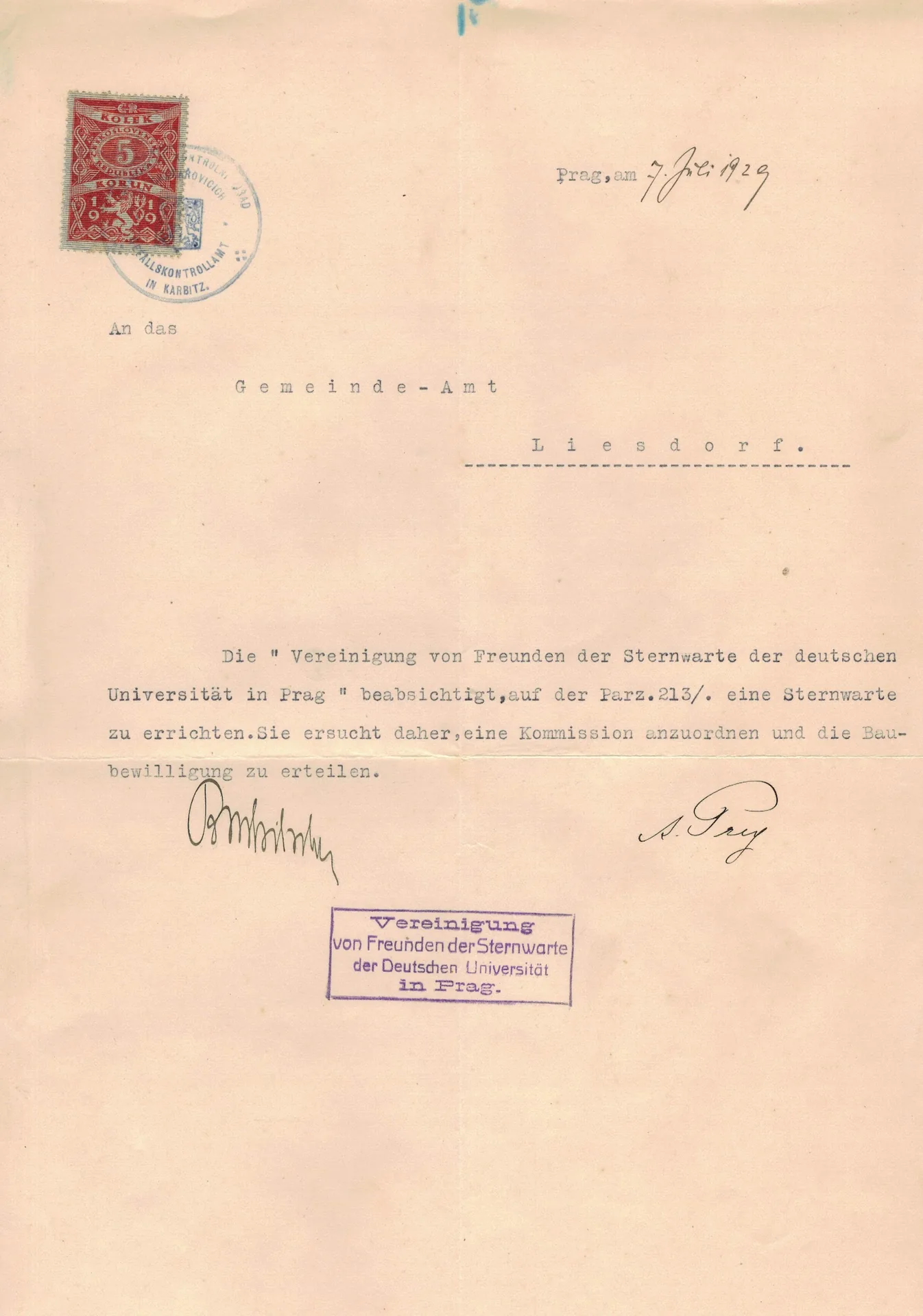
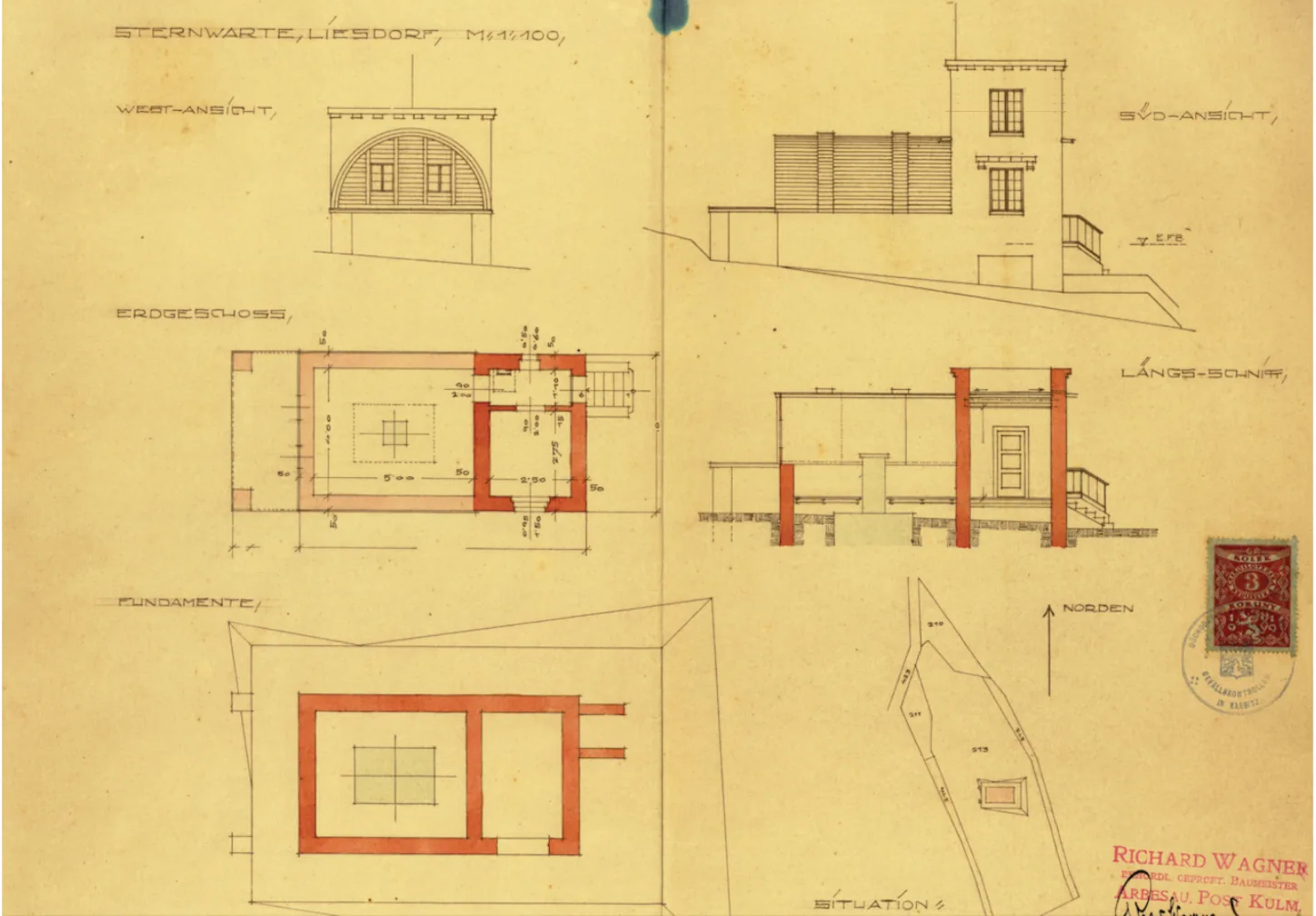
The association's application to convene a construction commission and to issue a permit for building on plot No 213 was preserved. The note in the building file is dated 23 July 1929. The project was processed by the esteemed builder František Eis and was carried out by Richard Wagner of Varvájov.
Application by the Association of Friends of the Observatory to convene a commission and permit construction on plot No 213, 1929. Source: archive folder of the North Bohemian Observatory.
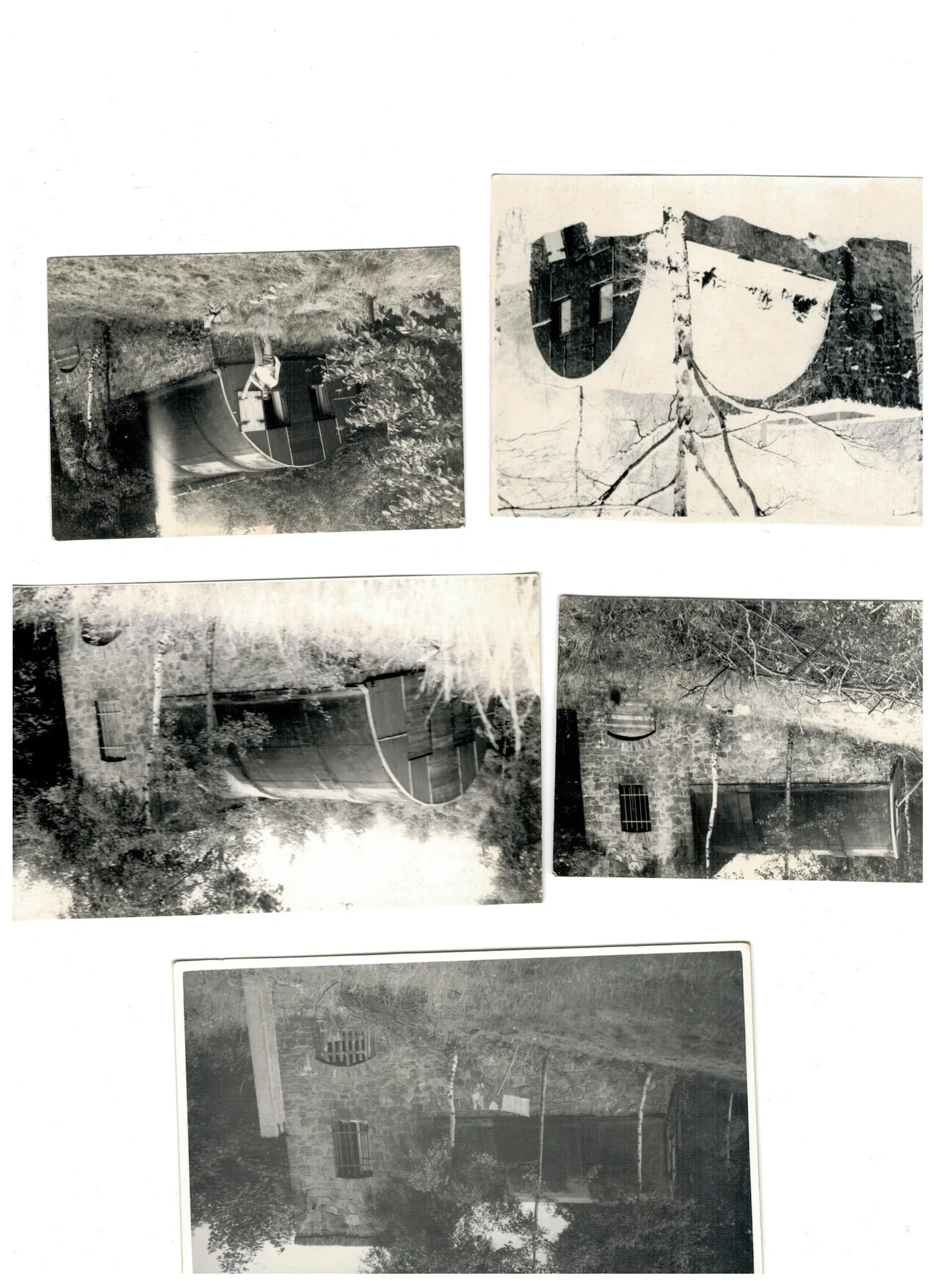
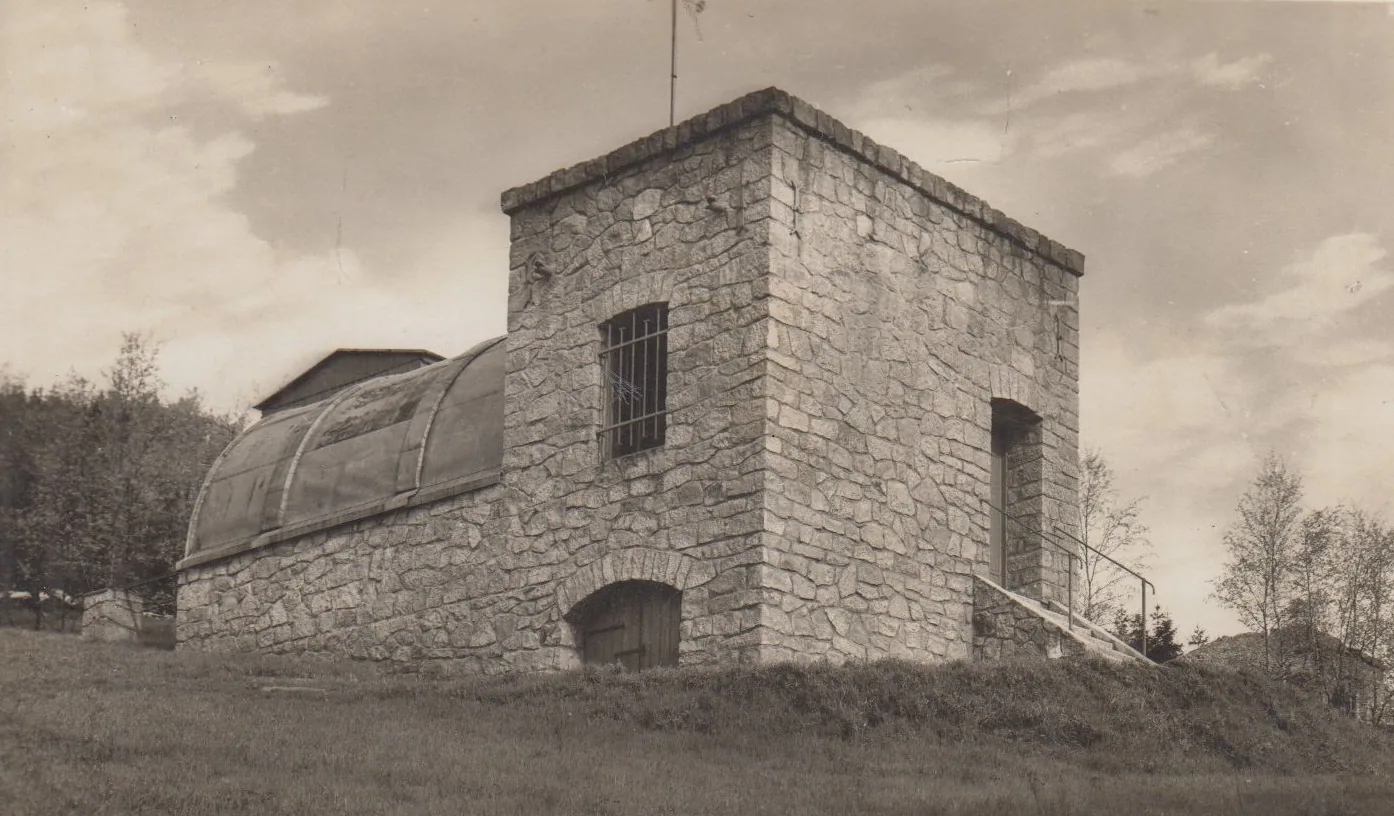
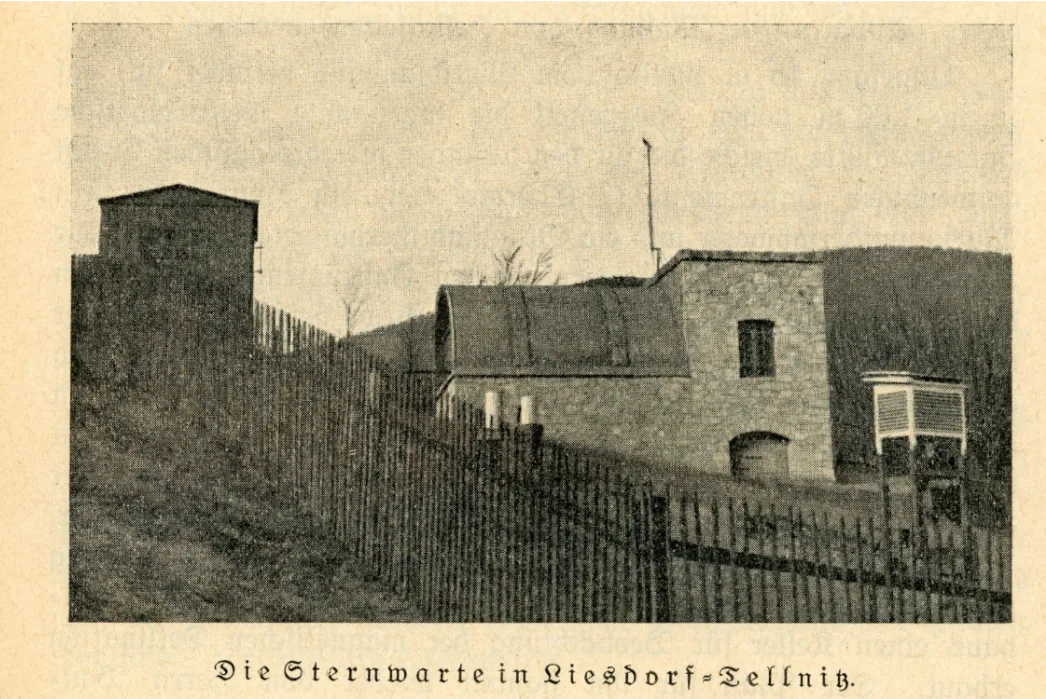
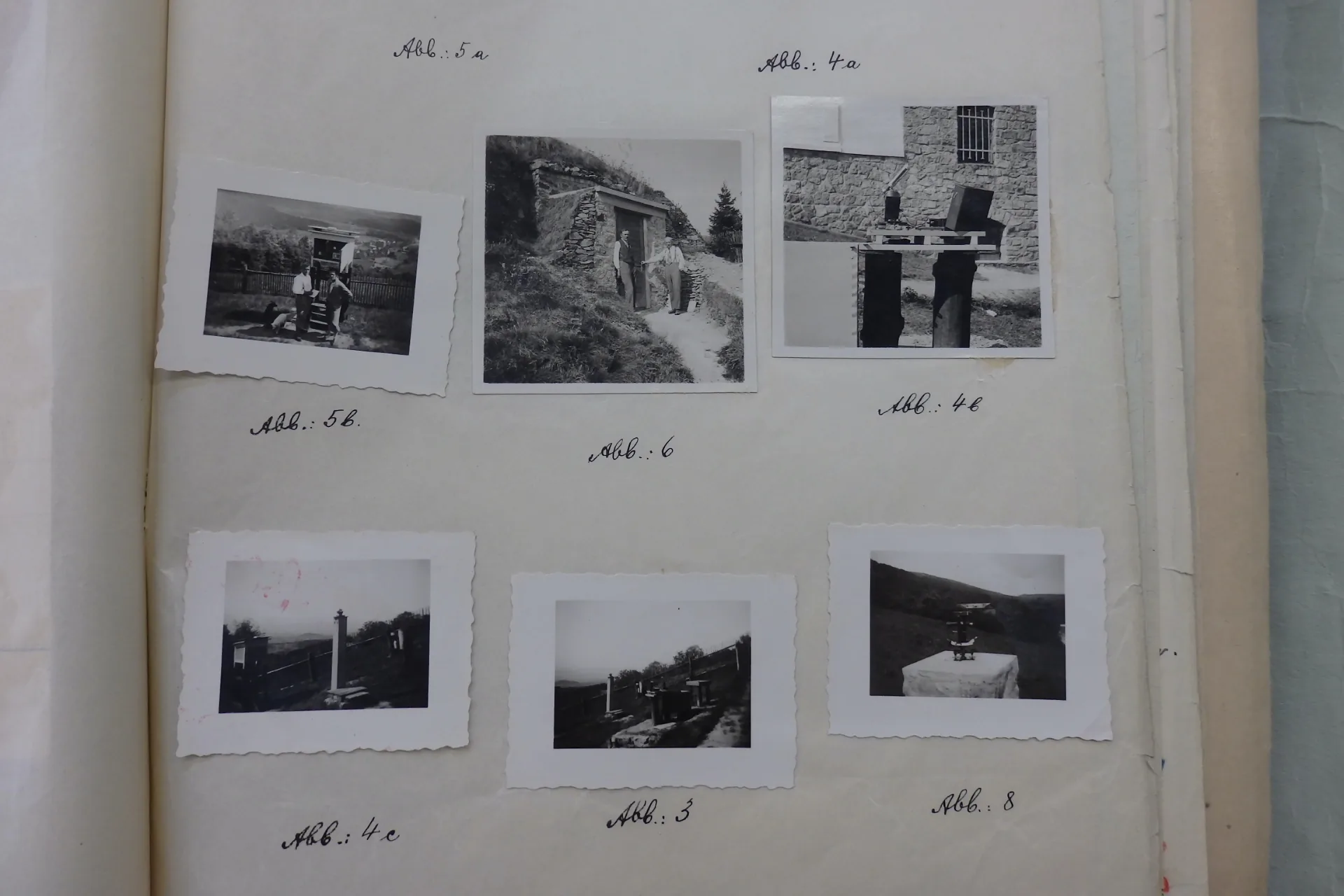
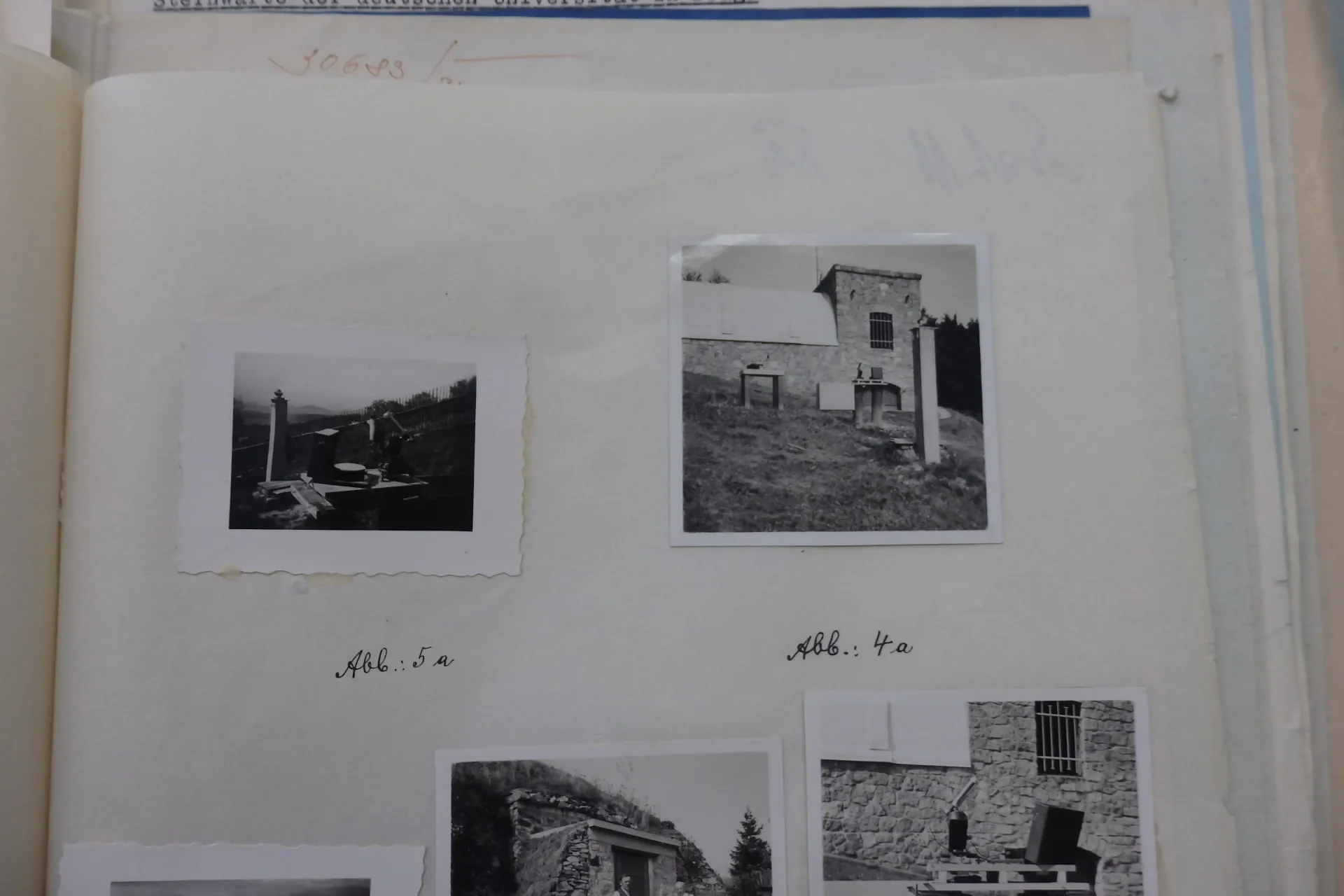
Stone building was 9 m long and 5 m wide Its longitudinal axis was exactly in the east-west direction. The eastern entrance was entered into the hall of approximately 1.10 × 2.50 m, where the station barometer was located. In addition, there was a space heater approximately 2.50 × 2.75 m for observers during long winter nights.
The main meridian room had a plan of 4 × 5 m. It was covered by a half-circle wooden roof with a diameter of 5 m, with double formwork and about 20 cm air gap limiting overheating. Two-thirds of the roof was on the rink and rails. Using the handle, worm transmission and gear wheels, they slid out to the west, creating approximately a two-metre slot and free view on both sides of the meridian. The large width of the opening was to accelerate the leveling of indoor and outdoor temperatures.
A period photograph of a stone meridian building with a sliding half-circle roof, 1929. Source: archive folder of the North Bohemian Observatory.
In the middle of the room stood on a separate concrete base pillar 1.55 m high, square section 70 × 70 cm. The foundation and the pillar did not touch the floor and masonry to prevent the shaking of the building from being transferred to the machine. Pillar carried a marble plate weighing approximately 200 kg.
At the end of the year, a broken transit instrument by Pistor & Martins with a 68 mm objective was installed and adapted for the Horrebow–Talcott method. The instrument made it possible to observe stars as they crossed the meridian. Köhler's description gives a magnification of 74×, with the option of 103×. The instrument had taken part in the Austrian polar expedition to Jan Mayen in 1882–1883.
The wooden hut housing the Steinheil refractor was moved to the new plot, approximately 10 metres north-west of the meridian building. Its roof mechanism was modified and fitted with a metal frame to resist icing. A Stevenson screen for the second-order meteorological station was installed about 15 metres to the south, and the site was fenced.
1929-1930: complete instrumentation
In addition to a broken arcade, the following devices were available to the premises or the parent institution:
- Steinheil equatorial refractor with 161- 163 mm lens, used mainly for photometry of variable stars.
- Töpfer wedge photometer with artificial star, Rosenberg device and von Gothard registration mechanism.
- Reichenbach's meridian circle with 108 mm lens; before use it should be upgraded.
- Straight transit instrument Fraunhofer-Starke with 108 mm lens.
- Broken transit instrument by Pistor & Martins with a 68 mm objective and equipment for the Horrebow method.
- Paralactic telescope Merz-Fraunhofer with 95 mm lens.
- Astronomical pendulum clock Hohwu No. 44 with mercury compensation and Hansen electric contact.
- Knoblich Box Chronometer No. 2036.
- Chronograph Fuess and later another chronograph Hipp.
- Mercury horizon, accumulators and radio receiver Telefunken for precise time signals.
The meteorological station contained two thermometers, a hygrometer, maximum and minimum thermometers, a rain gauge and a snow gauge. A Campbell–Stokes sunshine recorder on the roof automatically measured the duration of sunshine. A Richard thermograph, a Fuess barograph and a Fuess hygrograph were added later.
Since November 1929, Josef Mrázek has provided three daily meteorological readings. On the day of his regular week trip to Prague his wife Marie Mrázková took over the service. Monthly summaries were sent to the State Meteorological Institute in Prague.
Photometric work was limited in winter by severe frost and icing of the wooden roof. In the summer the observation of RR Arietis, α and γ Cassiopeiae, μ Cephei, U Delphini, X, g and α Hercules, R Lyrae, α Orionis, α Persei, β Pegasi and delta ² Lyrae continued.
1930: magnetic cellar and property extension
In 1930 he was the owner of Vereinigung von Freunden der Sternwarte der Deutschland Universität in Prag (Association of Friends of the Observatory of the German University in Prague).
The association bought additional 1,145 m ² west of the meridian building to create a reserve for further development. Around 40-50 m north of the main building, without the use of iron, he built a basement for measuring magnetic deposition. They contributed 5 000 CZK to the construction The Mostecký coal company and the North Bohemia coal company, because the precise knowledge of magnetic declination was important for mining metering.
The cellar had external dimensions of approximately 3,95 × 3,40 m, was largely embedded in the ground and covered with about a meter layer of soil to limit temperature changes. The construction was not allowed to use iron. The inner space consisted of a hall approximately 1,05 × 1,60 m and an instrument room approximately 1,75 × 1,60 m, both about 2,50 m high The variometer was subtracted by a telescope through the window, so the observer didn't have to enter the instrument room and change its temperature.
A high voltage three-phase line of 10,000 was checked before construction started. It was led about 150 meters from the compound. Josef Mrázek, Rudolf Tschilschke and engineer of the North Bohemian Power Plant carried out several hours of tests of complete shutdown, shutdown of phases and ground connections. The controlled magnetic declinator did not show significant interference of the lines on the planned measurements.
1930-1931: measuring latitude variation and exact time
In the autumn of 1930, Josef Mrázek began measuring variation in latitude by the Horrebow–Talcott method with the broken transit instrument by Pistor & Martins. Preparations were delayed by the construction and repair of the eyepiece micrometer, which had not been used since the Prague measurements ended in 1907. The micrometer's moving threads touched the fixed reticle, and the instrument had to be returned to the mechanic repeatedly.
Mrázek and Tschilschke have newly determined the distances of the fixed mesh fibres at 13 nights. Tschilschke was assigned to Telnice in March 1930, determining the exact time and the Steinheil refractor with the wedge photometer measured the brightness of red variable stars.
Sidereal time was initially checked with Knoblich box chronometer no. 2036. Because the clock pier was unstable, the Hohwu pendulum clock could not be installed in time and the chronograph set could not be put into operation. The pier was therefore dismantled and reinforced.
Josef and Marie Mrázek took turns in the weather service until March; Since the end of March 1930 he has taken over half of the time readings of Rudolf Tschilschke.
1931: the limits of an old transit instrument, solar radiation and geomagnetism
In the summer of 1931 Mrázek had to end continuous measurements of the variation of latitude. The Pistor & Martins machine had severe mechanical defects already known from Prague measurements from the end of the 19th century and other defects were added. In the given state it was not possible to capture precisely the variations in pole height.
Mrázek nevertheless used the instrument for several preliminary longitude determinations by means of coincident time signals from the German station at Nauen. A definitive longitude determination and a longer series of latitude-variation measurements were postponed until the instrument could be overhauled.
In the fall, the solar intensity measurements began. The Geophysical Institute of the German University rented a pyrheliometer Moll-Gorczynski and a handheld millivoltmeter Chauvin & Arnoux. Since July Mrázek has simultaneously performed an absolute determination of magnetic declination at the weather observatory in Milesovka.
Rudolf Tschilschke carried out time measurements by the transit instrument and photometry of the red variables with the Steinheil refractor. In summer, however, because of the illness, he had to completely interrupt the observation.
The instrumentation was extended by Lindemann's electrometer with microscopic reading, Ohemo jammer for radio, Campbell-Stokes heliographer and solar camera for boards 9 × 12 and 13 × 18 cm, donated by A. Kraus from Mikulášovice.
1931-1932: completion of magnetic station
The economic crisis has stopped the planned construction expansion, but the technical equipment has been supplemented. On the new pillar were hung clock Hohwu no. 44, installed Fuess chronograph and radio set Telefunken with wavelength range up to 20,000 m. The weather station received a registration thermograph Richard, barographer Fuess and hygrograph Fuess.
In December 1931 two variations were placed in the magnetic cellar: one for magnetic declination and the other for horizontal intensity of the Earth's magnetic field.
In the autumn of 1932, the measurement of solar radiation continued with the pyrheliometer Moll-Gorczynski. The State Meteorological Institute lent a registration millivoltmeter to Richard. In September 1932 regular observations of magnetic declination began three times a day following meteorological deadlines. The absolute determination was made by Josef Mrázek, the usual period readings were divided by Josef and Marie Mrázek.
1932: death of Rudolf Tschilschke
The primary sources consistently show that Rudolf Tschilschke died on 19 October 1932 after a long lung disease in the Ústí sanatorium and was cremated on 22 October. Born January 25, 1902 in Krakow, studied at the German State Realtor in Prague and in 1926 he obtained a doctorate in natural sciences. After that he became an assistant and was assigned a Telnice observatory. His condition has been deteriorating since 1929.
Shortly before his death, he referred his science library to the observatory on 118 volumes. The vacancy was not filled in the following year.
Note to the disputed date: Wikipedia and part of secondary literature reported October 10, 1933. This date is in conflict with the period obituary in Österreichische Wehrzeitung and the annual report of the Astronomical Society for 1932, which recorded death on 19 October 1932. The date of 19 October 1932 is therefore used in this chronicle.
1933: Daily measurements continue, night astronomy stops
After Tschilschke's death, Josef Mrázek remained the only astronomer permanently active in Telnice. It continued in the pyrheliometric measurements of solar radiation, absolute measurements of magnetic deposition and meteorological service. Regular declination readings took place three times a day.
A small hall was added to the magnetic cellar. The original door cracks released warm wet air and the instrument room could not be kept dry. Night astronomical observations had to be stopped due to lack of personnel. The annual report explicitly states that it could not be renewed until after the appointment of a new auxiliary force.
1934-1938: personnel crisis, stop lines and plan to leave the station
After the departure of Professor Adalbert Preye to Vienna in 1930, the astronomical department remained vacant for a long time. The Institute was temporarily led by Professor of Physical Chemistry C.L. Wagner. In Telnice the operation was mainly held by Josef Mrázek with the help of his wife. The economic crisis has limited construction plans and the staffing emergency has made it impossible for a full astronomical program.
At the end of September 1936 a Telnice was instructed to stop the weather service immediately. A period article by Josef Mrázek from 1939 states that this ended a continuous meteorological series lasting six years and eleven months. The same fate affected geomagnetic observations. The Director of the State Meteorological Institute in Prague tried to promote the continuation of meteorological measurements.
In January 1937 Professor Erwin Finlay Freundlich ordered the complete abolition of the small observatory in Telnice. The reason was the plans of a large university observatory near Prague and later a reflection on the common Czech-German observatory south of Prague. The plans didn't happen. The operation in Telnice was stopped, but the site was not completely destroyed before the change of political circumstances.
In October 1938, the site remained within a new administrative framework after the Nazi Germany border. The 1939 article describes this fact in an age-propaganda language. For today's historical use, it is necessary to separate the factual description of the station and equipment from the political rhetoric of the author and editorial.
1939-1940: attempted new use and repairs
In 1940, the German Astronomical Institute Werner Schaub took over. The association of friends of the observatory was abolished by the decision of the Reich Protector and his property, including the Telnice observatory, moved to the German Charles University. The property records show Deutsche Karls- Universität in Prag for 1940.
One of the buildings, the wooden hut housing the six-inch refractor, was close to collapse and was repaired before winter. Josef Mrázek oversaw the work and also processed the latitude observations from 1930–1931.
Schaub evaluated an old 68mm gauge device and a six-inch refractor for research at the time as insufficient. The German research company therefore lent a 20 cm mirror telescope from Kiel. In September 1940 the mechanic of the Leipzig Observatory took it apart and transported it to Telnice, but because of the heavy snow it was no longer installed in the given year.
A powerful spectrograph with a small dispersion was designed for the new device. The plan was to take records in Telnice and to process them in Prague with Askania photoelectric microphotometer with differential wall photoelectric cell. The tests showed a range of five star sizes with an internal accuracy of approximately 0,01 magnitudes.
Two rooms were rented in Telnice for the living and work of the staff because the observatory itself did not have a residential facility.
1941: last university experiment and final shutdown
At the beginning of 1941, the operation was still being restored. Assistant H. Oehler was to temporarily work in Telnice with Josef Mrák, install a 20 cm mirror telescope and launch a photometric program. The assembly was repaired in Telnice and Prague, the mirrors were newly coated with aluminium and the buildings were repaired.
The observation of additional stars for the FK3 catalogue by a portable meridian circle with a 100 mm lens was also planned. However, the programme thwarted the lack of staff, the occupation of Oehler to the army and the unfinished meridian circle.
The annual report shall also identify practical reasons for closure. The observatory had neither water nor electric light. Accumulators had to be charged off site and the station was difficult to access in winter. Connecting to the electricity network was considered too expensive and water supply virtually impossible. In addition, the connection between Ústí and Telnice stopped during the heavy snow.
It was therefore decided to shut the station down completely. A 20-centimeter mirror telescope was taken to Prague. Other old devices were packed and should have been transported as appropriate. The annual report explicitly states that a later renewal in Telnice was not foreseen.
Josef Mrázek left the observatory on 31 December 1941 after working at the Observatory in Telnice. This primary document is important to assess the later claim that it managed the station without interruption until 1945.
1942–1945: a wartime episode and unresolved questions
In 1944, Reichsstatthalter im Sudetengau - Gauselbstverwaltung was led as owner of the observatory. This property figure must be distinguished from the question that an institution has actually carried out measurements on the premises.
Later literature and Wikipedia report that the site was used by the German Upper School in Duchcov to measure the Earth's magnetic field by important mining measurements. According to this secondary reconstruction, a chronometer was purchased for astronomical determination of azimuth measurements down, a declination measurement started in April 1942 and a declination variometer of its own design with three daily readings was installed in the basement in December of the following year.
These figures are not confirmed in the available annual reports of the German university observatory for the years 1940 and 1941, as the 1941 report, on the contrary, describes the complete shutdown of the university station and the removal of equipment. So it could be a subsequent use of the magnetic basement by another institution. For a definitive interpretation, the original records of the Upper School in Duchcov referred to by secondary literature should be traced.
Similarly, it is necessary to carefully treat the tradition that Josef Mrázek remained in Telnice until 1945 or until his death in 1946. The primary annual report confirms his departure from the University Institute at the end of 1941; However, it shall not exclude its later local or meteorological activity from this employment relationship. Without another direct source, both statements cannot be identified automatically.
1945-1959: removal of equipment and transformation into a recreational object
After the demise of the University of Germany, its scientific institutes and property came to Charles University. In autumn 1945 the equipment of the German Astronomical Institute, including devices from Telnice and preserved library from the Prague Luxembourg street, was transported to Ondřejov.
The original Steinheil refractor is still preserved in the Ondřejov Observatory according to modern archive research. The archive image folder contains detailed photographic documentation of the tube, assembly, transmission and controls.
Photographic documentation of the original Steinheil six-inch refractor, today stored in Ondrejov. Source: archive folder of the North Bohemian Observatory.
The area was taken over by the State Forests. According to the Wikipedia summary, the building was rented as a recreational facility in 1951. In 1952 he applied for it from a school paper in Ústí nad Labem. In June 1953 she was reassigned to recreation to Jiří Auředník and Miloslav Skál. On 31 May 1954 it belonged to the national company Meva for civil defence purposes and in September 1956 it was leased to Jarmile Kubíček from Střekov.
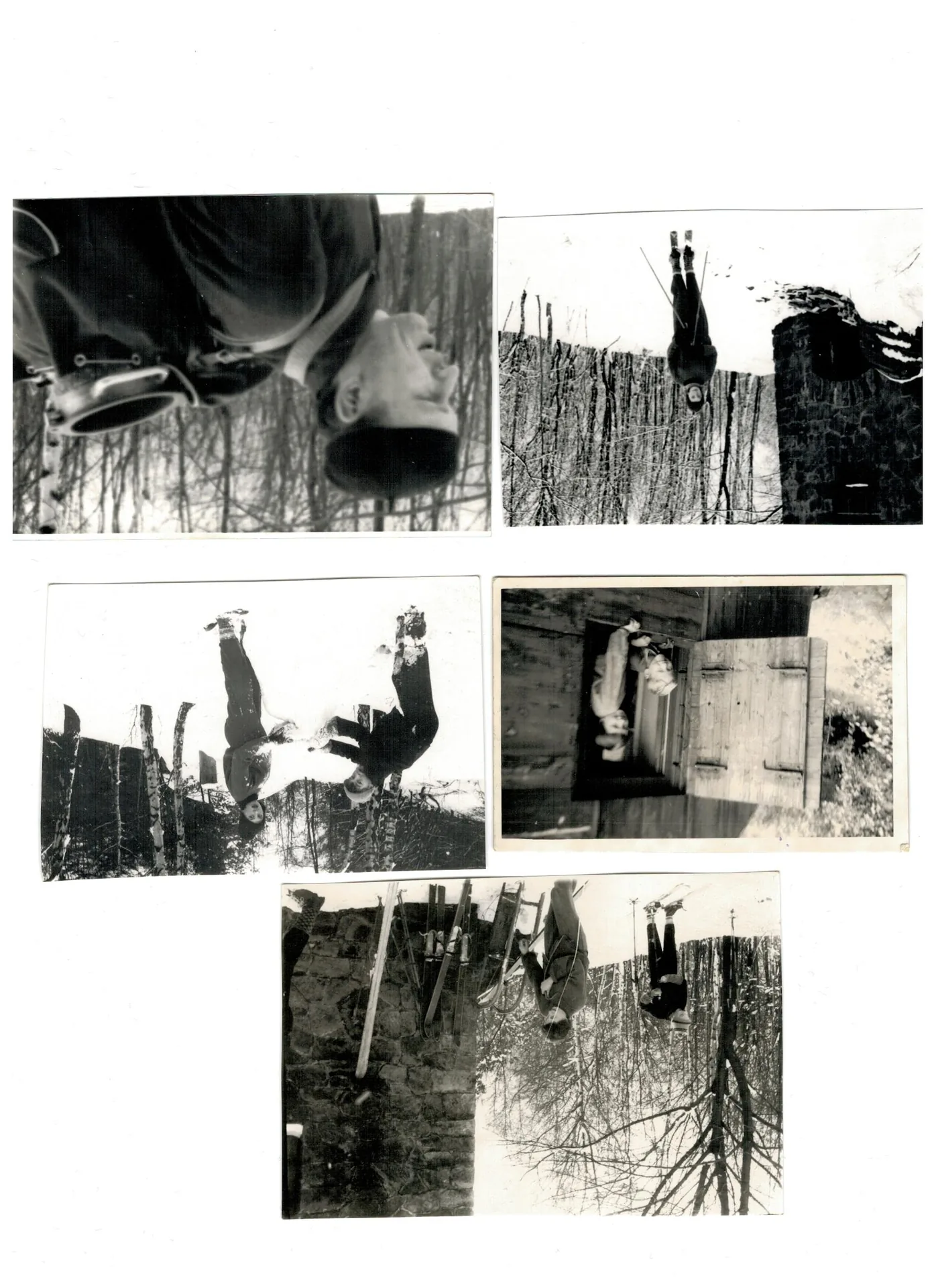
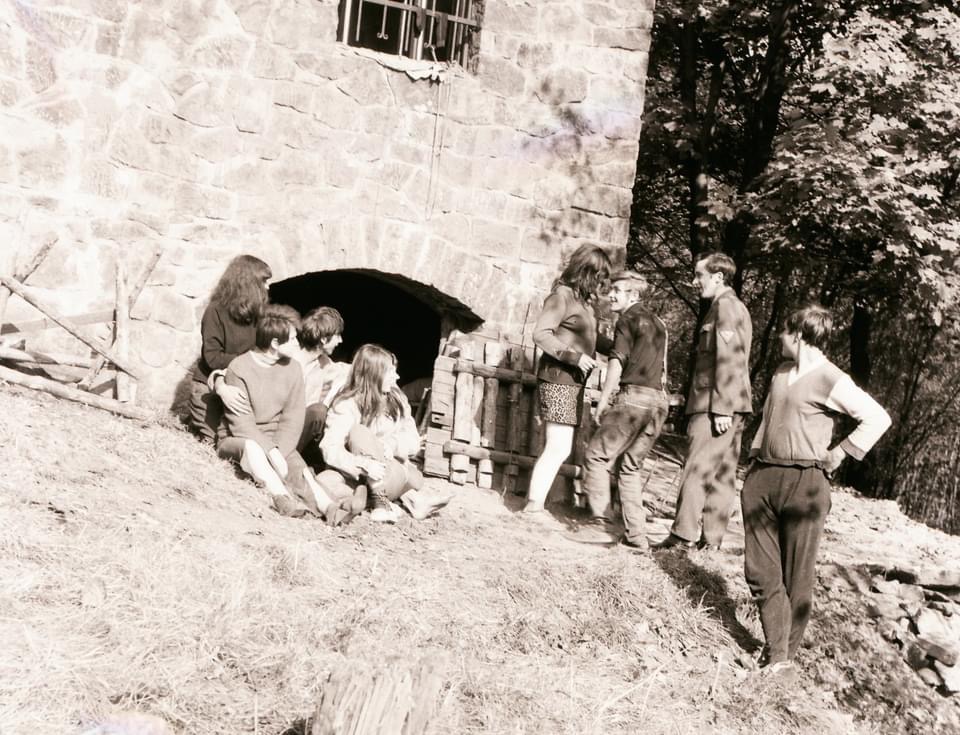
The archive film marked "Telnice Observatory 1955" captures a group of people near a stone building. The photograph should be understood as evidence of post-war recreational or civilian use; the exact persons are not specified in the filename.
A group of people at a still standing building, dated back to about 1955. The exact identification of persons is not documented. Source: archive folder of the North Bohemian Observatory.
1960-1979: cottage, decaying and attempt by amateur astronomers
 Archive / 1969North Bohemian Observatory in 1969Play on YouTube ↗
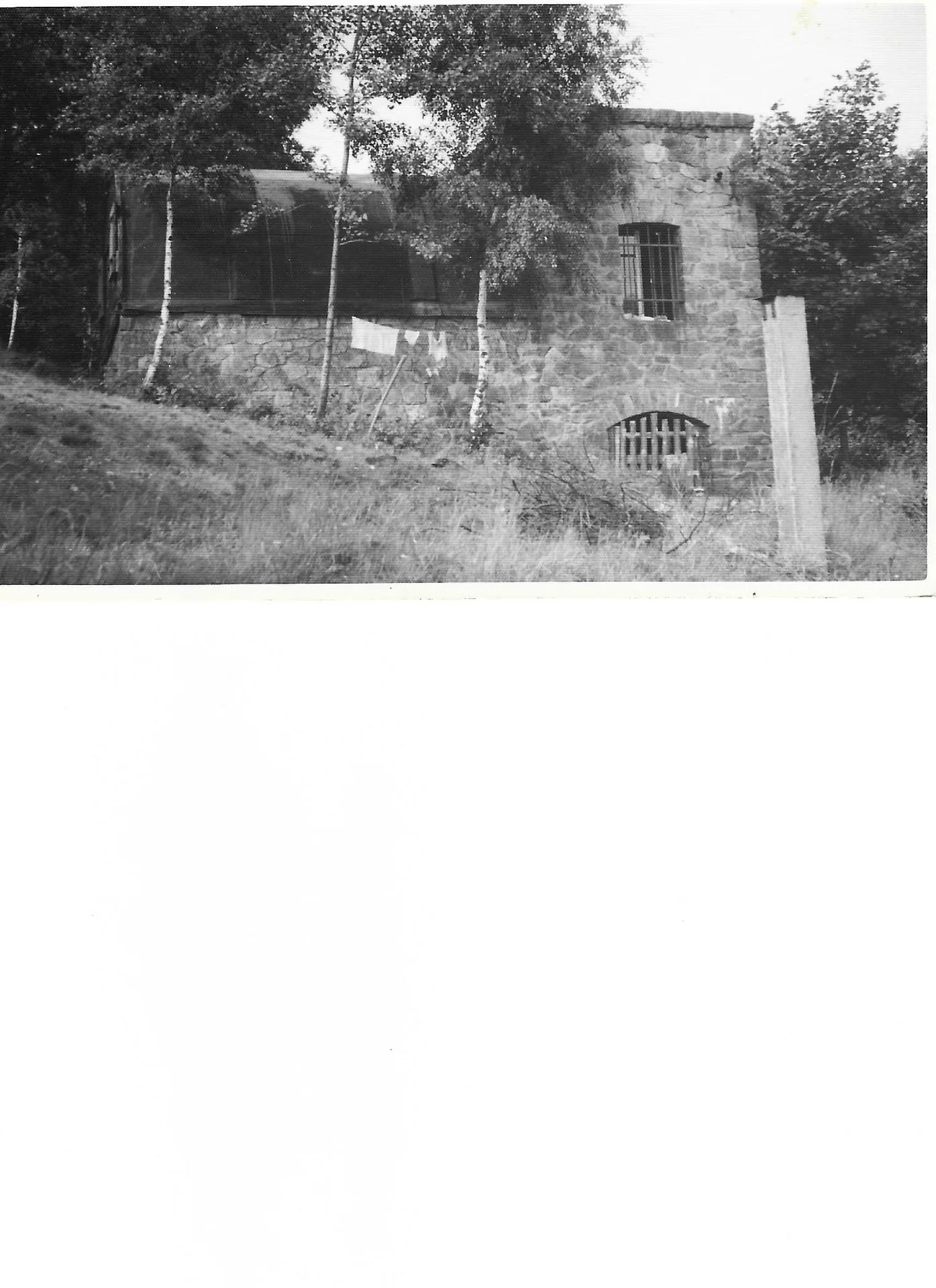
Around the years 1960-1969 they used the building as a cottage of the family of František Adam and Eduardo Taske. The object was still maintained during this period. After 1970, he switched to other tenants and quickly started to lose it. The photographic component marked "1970 'captures groups of visitors at still standing stone building in winter and without snow; is a significant image document of the last phase of its use.
Visitors in front of a stone building around 1970, when the building still served as a cottage. Source: archive folder of the North Bohemian Observatory.
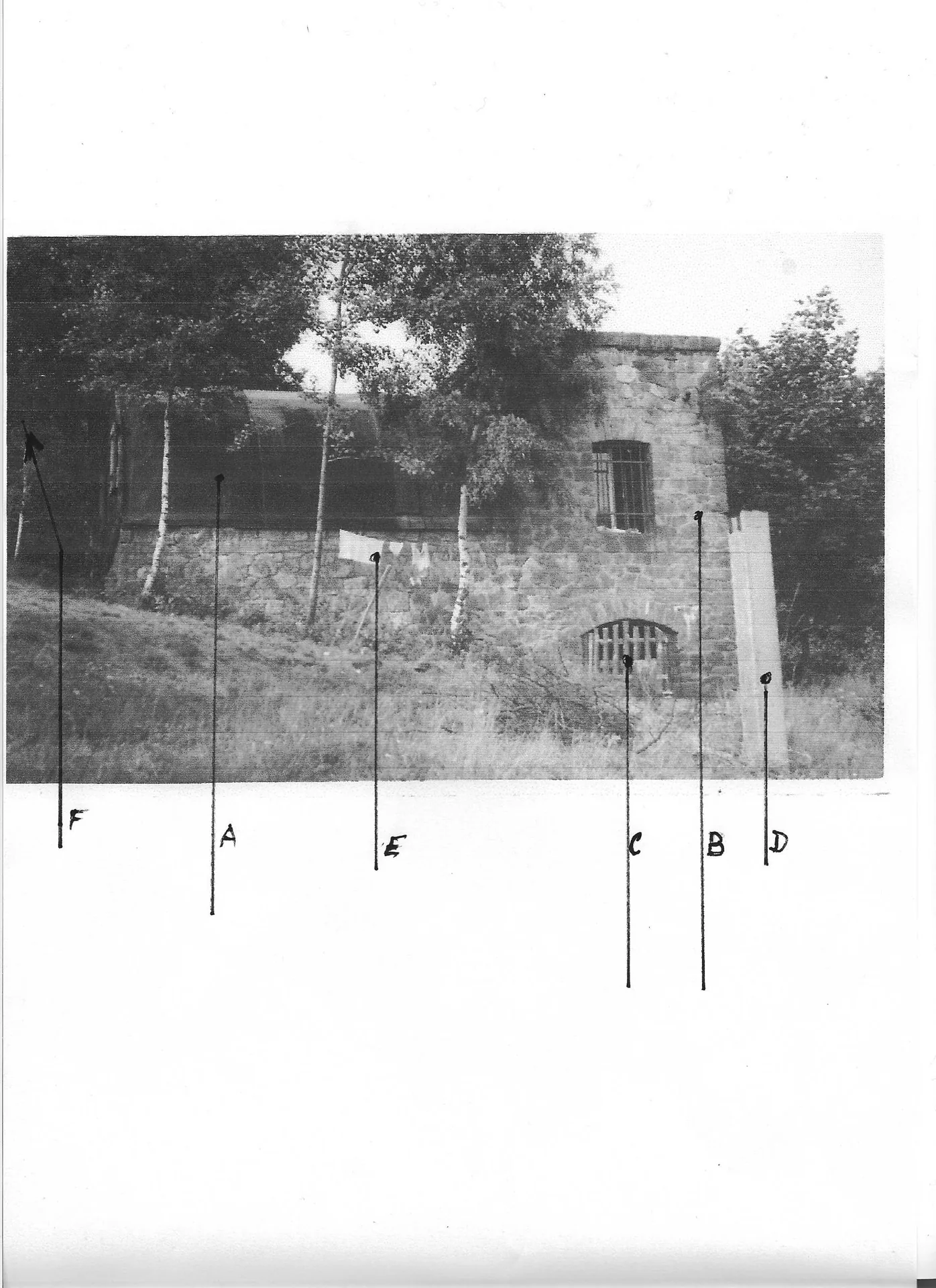
In the summer of 1977, members of the Ústí astronomical club Lamb, Erlich and Václav Slavík conducted a survey. The access route was so overgrown that the building could not even be reached by the terrain car. The building had windows knocked out and the roof was damaged. There were columns in the area that could serve as pedestal of smaller telescopes, and on the north side of the property there was a cellar in the slope.
Local residents reported that there were tramps and fires and riots. Astronomical club found that the object belongs to North Bohemian state forests, forest plant Litvinov, and is rented to a private person for recreation. The circle considered renewal for amateur astronomy, but it pointed out that remote, poor accessibility, vandalism, and the fact that working with the public would be more appropriate in Ústí nad Labem.
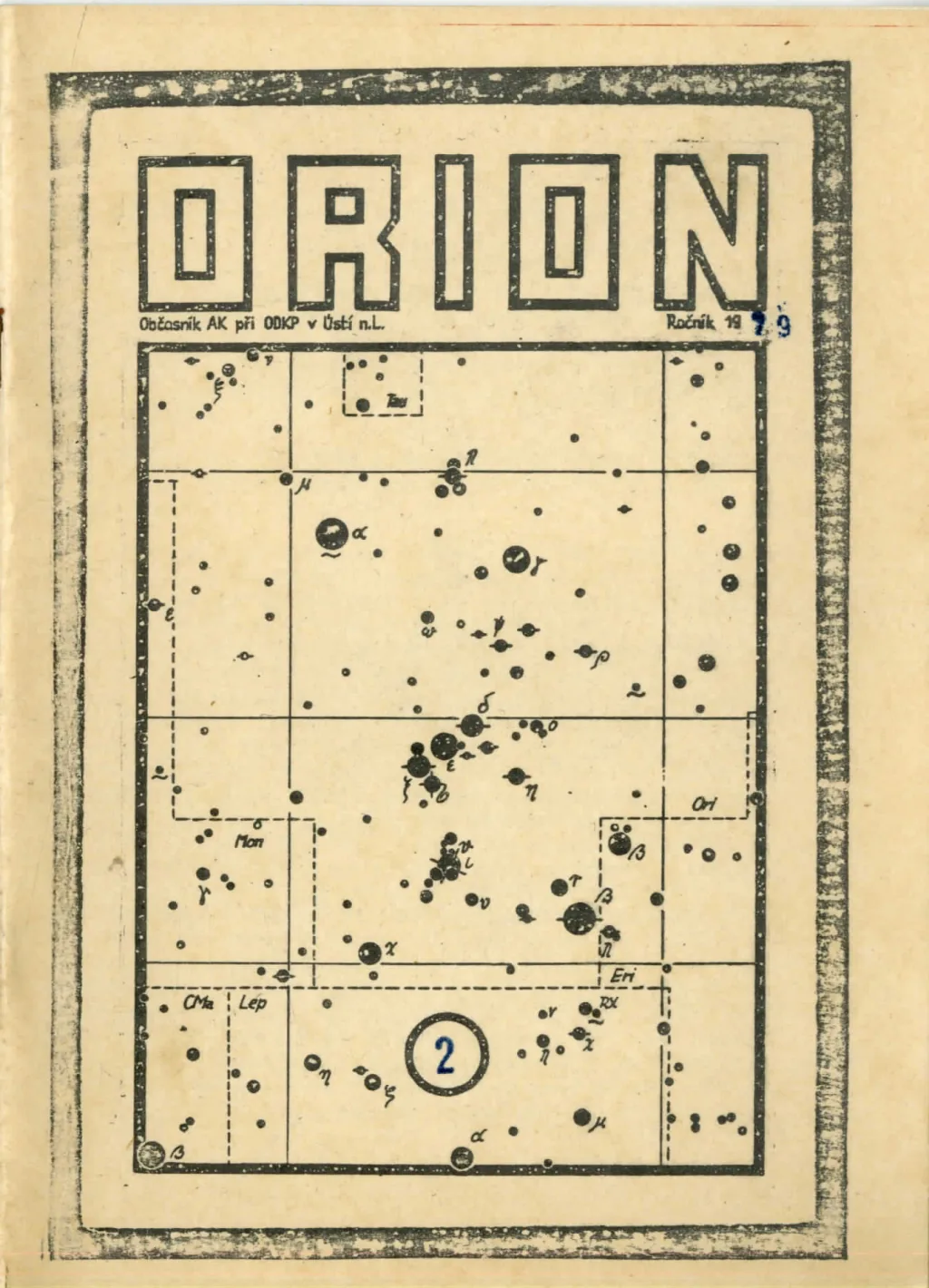
The article Václav Slavík and Jaroslav Körner was published in 1979 in Orion magazine. Its full information content is incorporated in this chronicle during the relevant periods: the establishment of the association, the description of the building and apparatus, the scientific programmes, the status in 1977, the property situation and the call for rescue. Short characteristic passage:
"The building of the former observatory in Telnice could be used for amateur astronomical activity even today."
Full printing of the whole article is not necessary for the chronicle; precise archive reproduction is preserved in Casopis Orion.pdf and is shown in sources.
The cover page of Orion magazine, year 19, No 2 (1979); The article also contains a situation map of the observatory and its surroundings. Source: Casopis Orion.squirt archive file.
1980–2021: the loss of the above-ground building
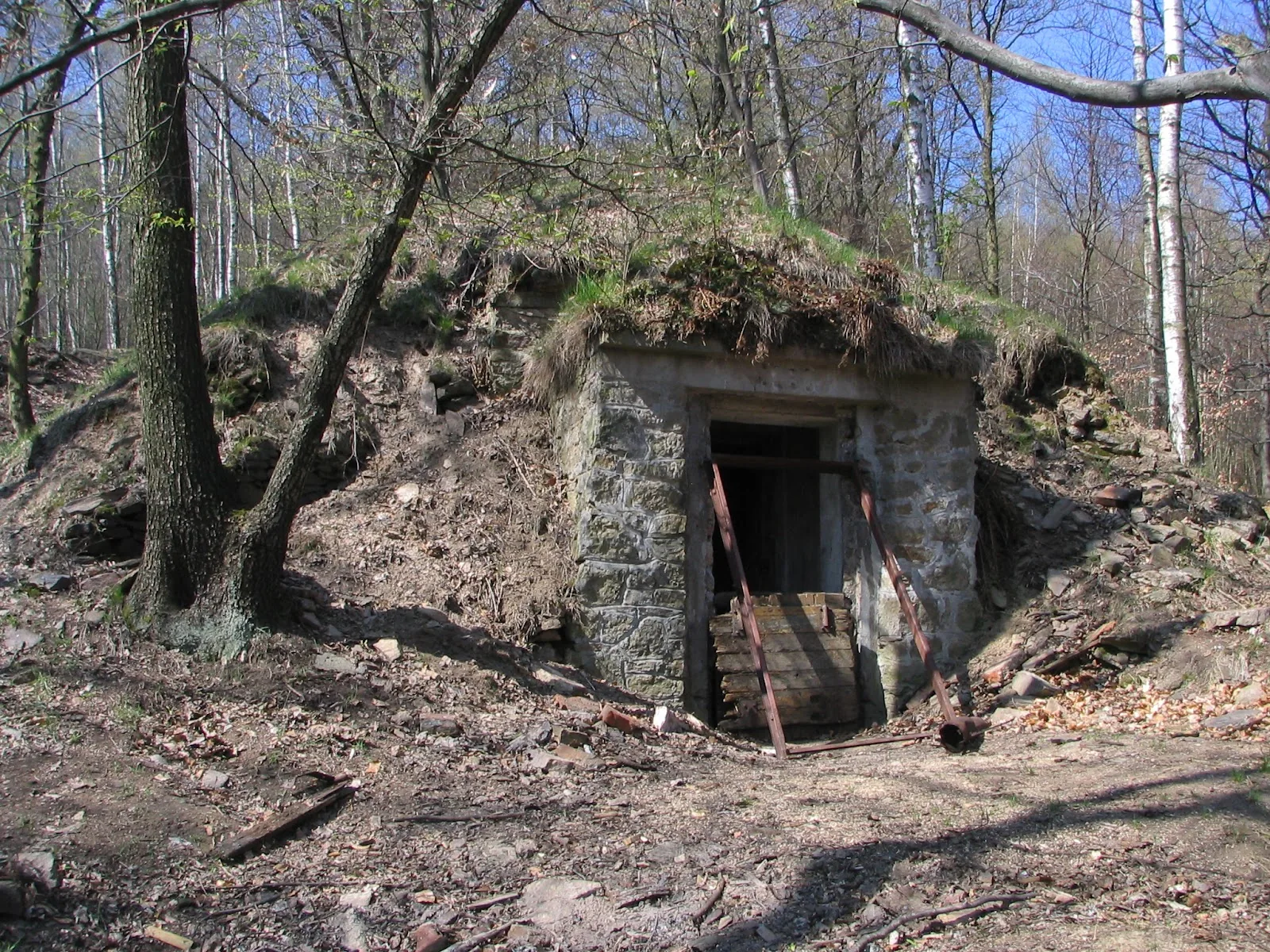
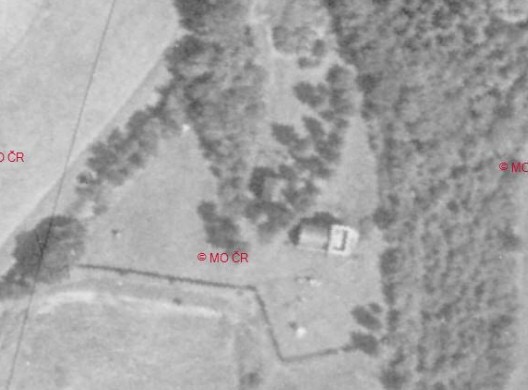
In the next decades, the stone building almost completely disappeared. The 2008 photographic documentation shows a rubble field, parts of masonry and bricks, secluded concrete and stone feet, metal remains of structures and preserved access to the earth's magnetic cellar. The above-ground observatory was no longer readable as a building; its floor plan could only be reconstructed from off-road relics.
The preserved entrance to the basement in 2008, the most resilient part of the original scientific site. Source: archive folder of the North Bohemian Observatory.
The magnetic cellar remained the most prominent preserved element. His introduction into the slope, strong masonry and ground cover, originally designed for thermal stability and magnetic purity, allowed him paradoxically to survive longer than above-ground observation objects.
2022: purchase of the premises and start of restoration
In January 2022, Vít Musílek and Viky Yang purchased the land. The goal was reconstruction of the historic observatory, public access, education, sky observation and future scientific cooperation.
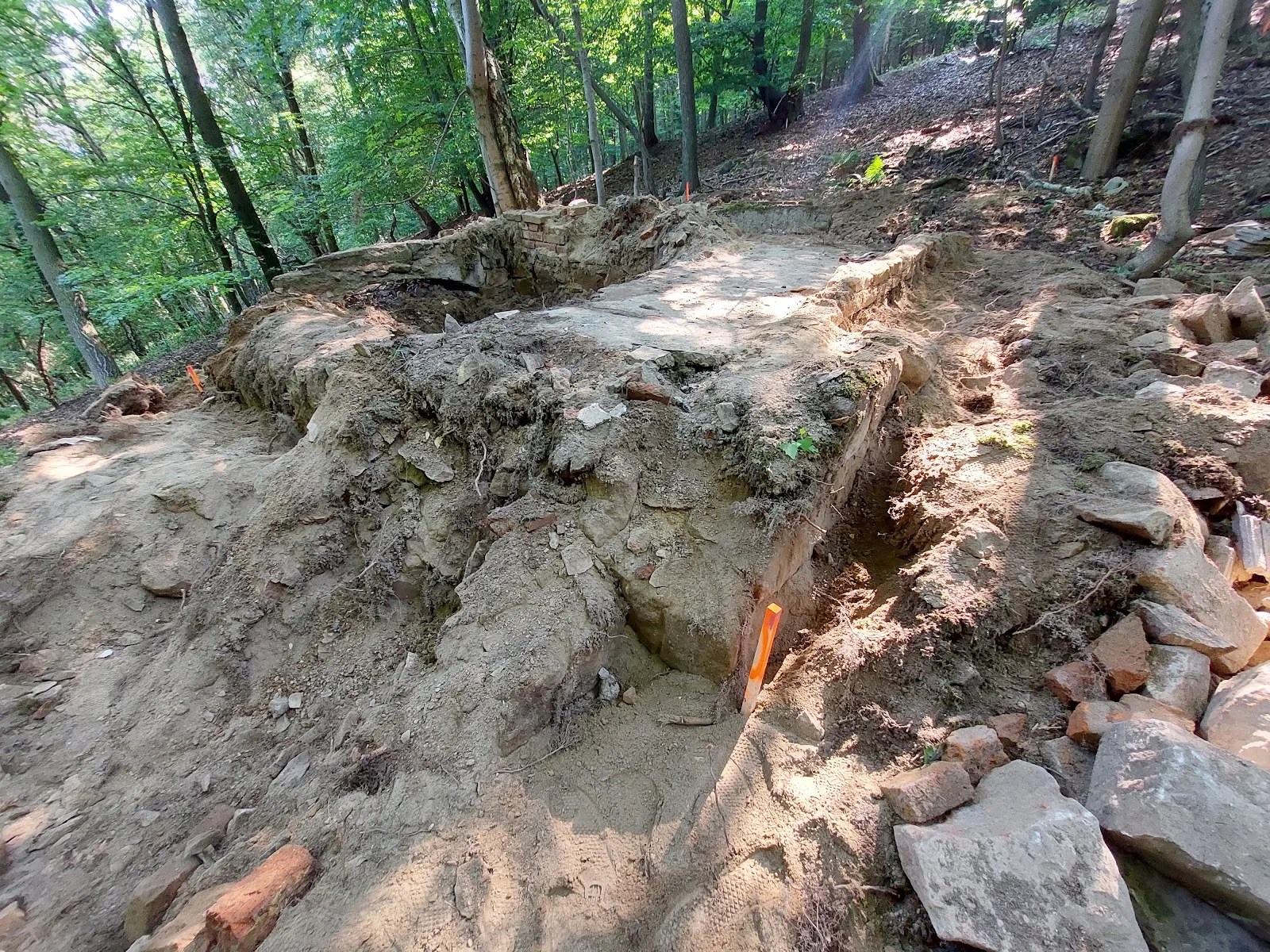
Followed by archival research, searching for building plans, period photographs and instruments. The original building documentation and the preserved Steinheil refractor in Ondrejov were identified. The field photos from 2022 document the uncovering of the foundations, cleaning and restoration of the historical cellar and the initial work in the overgrown area.
Unveiled foundations and terrain work in the initial stage of restoration of the site. Source: archive folder of the North Bohemian Observatory.
The Association of the Ustecká Observatory is established, which coordinates the reconstruction. The modern concept links historical reconstruction, public astronomy, education, historical research and new experimental projects.
2022-2026: land, construction and negotiations with the Forests of the Czech Republic
According to the documents provided by the owner, the meetings of the association, the municipality of Telnice and the state firm of the Forests of the Czech Republic have been held since 2022 on the land needed for the development of the complex. Geometric plans and expert reports were prepared and both personal and written negotiations were conducted.
The proposed solution was changing over time. Originally, the exchange of land between the forests of the Czech Republic and the municipality of Telnice was prepared; later, variants of direct sales or long-term pacht appeared. The changes brought about repeated negotiations and an extension of the process.
A building permit has been issued for renewal. The forests of the Czech Republic appealed against him and the proceedings continued at the Regional Office of the Ústí Region. The owner's documents also draw attention to delays in the delivery of documents. Administrative uncertainty limited the scope of construction works, while the association continued to restore cellars, scientific and popularization projects and build facilities.
In 2026, a petition requesting a transparent, predictable and timely settlement procedure was published. This modern part is based on information supplied by the owner; the complete administrative file and the text of the petition were not part of the analysed archive folder. It is therefore appropriate to add reference numbers, exact dates of the decision, the text of the appeal and the reference to the petition before public legal or media use.
2024-2025: PRIM space project
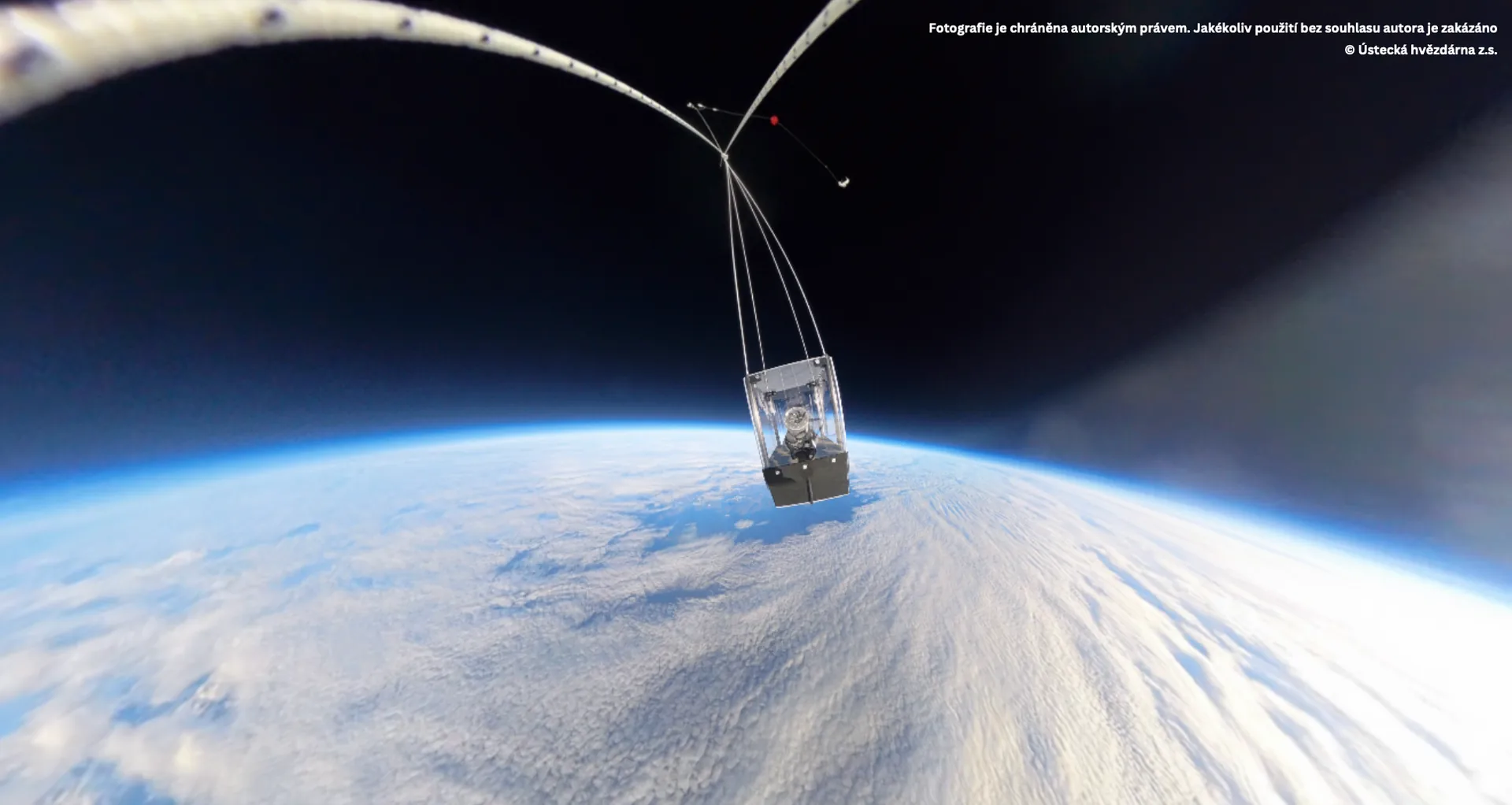
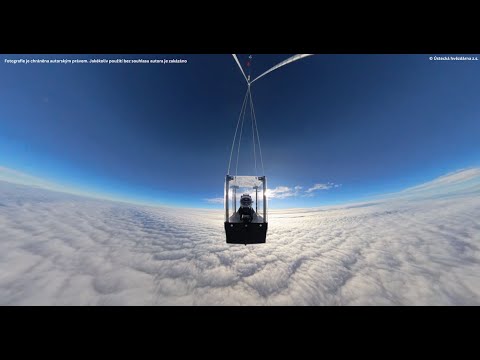 PRIM into Space / 2024North Bohemian Observatory: A watch in the stratosphere 1/5Play on YouTube ↗
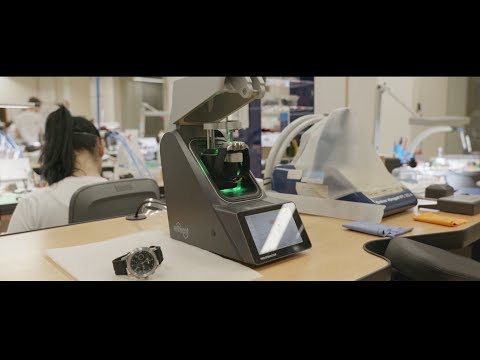 Recovery and testing / 2024PRIM TYCHO BRAHE KOSMOS LE | Testing after the return from the stratospherePlay on YouTube ↗
The PRIM project into space was created as cooperation between the North Bohemian Observatory and ELTON watchmaking company, producer of the PRIM watch. It was initiated by Vít Musílek after visiting the manufacturer's shop in Nové Město nad Metují. The aim was to combine the Czech watchmaking tradition with the history of astronomy, to raise awareness of renewal and to raise the resources for reconstruction.
A special model, the PRIM TYCHO BRAHE KOSMOS, was created. Its caseback bears the night sky of 1949, the year associated with the beginning of Czechoslovak watchmaking. The name refers to the astronomer Tycho Brahe.
The first prototype benefit auction ended on September 22, 2024. According to the project, the price reached CZK 390 000 and the proceeds were intended to support the reconstruction of the observatory.
In December 2024, a specimen of watches was carried by a high-rise balloon into the stratosphere. Spacemanic confirms the implementation of the mission on the weekend before 16 December 2024. The watch was placed in a transparent case under the balloon to be photographed above the Earth against the dark sky.
The project documentation shows a height of approximately 31 km, a temperature of around -70 ° C and a speed of up to 276 km / h. Wikipedia indicates a speed of 286 km / h. Until the original telemetry record is available, it is appropriate to state in the final publication that public resources differ in the maximum speed data. On return, the watch was found and its functionality verified.
The subsequent auction of the specimen that passed the stratospheric flight was described in the media in spring 2025. The proceeds were designed to reconstruct the observatory. The project became the first great media event of the new era of the complex and connected a historical monument with modern technology, experiment and popularization of science.
Instruments and their actual use
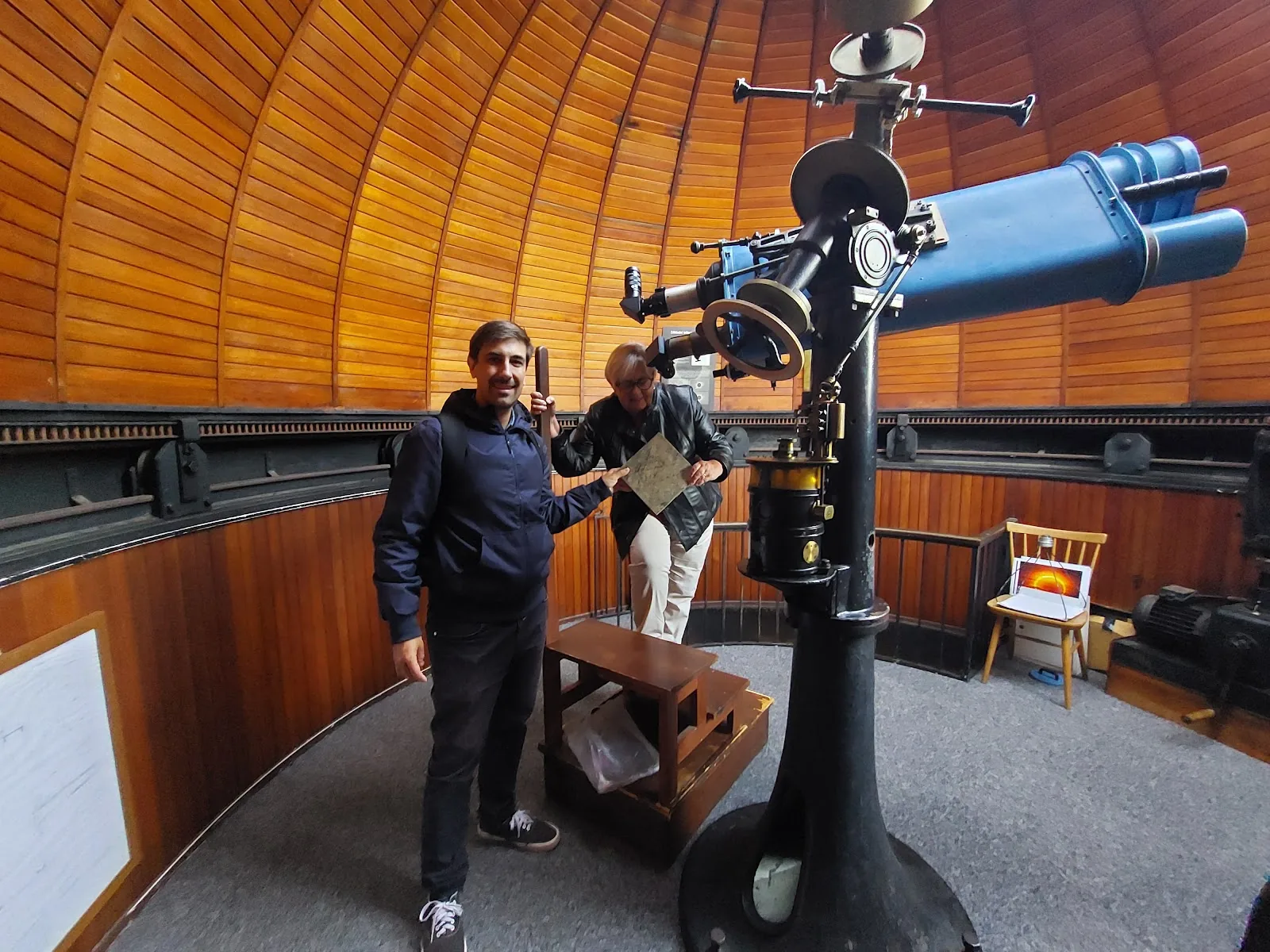
Steinheil's six-inch refractor
The lens equatorial telescope with a lens approximately 161- 163 mm has been the main device of the station since 1924. He was standing in a wooden house with a sliding roof. It served primarily the photometry of variable stars, not just the demonstration of the sky. With the Töpfer wedge photometer, the artificial star and the registration mechanism made it possible to compare the brightness of the observed star with the calibrated light stimulus.
Shrink Transit instruments Pistor & Martins
The 68 mm lens device was placed on a separate pillar in a meridian building. It was used to determine the exact time from the passing of the stars by the meridian, to measure the latitude of the Horrebow-Talcott method and to determine the longitude by means of time signals from Nauen. His mechanical defects in 1931 made it impossible to plan a long series of accurate measurements of pole height.
Reichenbach's Meridian Circle and Fraunhofer's Starke Transit instruments
Both instruments had a 108 mm lens. Reichenbach's circle should have been upgraded before it could take over the main measuring program. The instruments came from the older Clementinum inventory and document the transmission of the instrument tradition from Prague to Liboňov.
Clocks, chronometers, chronographs and radio
The exact timing was provided by box chronometer Knoblich No. 2036, later the Hohwu clock No. 44 with mercury compensation and Hansen contact. Fuess's chronograph electrically recorded second impulses of the clock and moments of star passage. Telefunken's receiver was used to receive scientific time signals from Nauen and Paris.
Meteorological instruments
The Second Order station had a station barometer, two thermometers, a hygrometer, a maximum and minimum thermometer, a rain gauge, a snow gauge, a Campbell-Stokes heliographer, a thermograph Richard, a barographer Fuess and a hygrograph Fuess. The standard regime represented three daily time readings.
Solar-radiation instruments
Pyrheliometer Moll-Gorczynski with millivoltmeter Chauvin & Arnoux measured direct sunlight. Later, Richard added the registration millivoltmeter. Planned actinometric measurements in the solar eclipse in 1927 thwarted cloud cover.
Magnetic instruments
In the iron-free basement, the variation devices for magnetic declination and horizontal intensity worked. The absolute values of the declination were determined by Josef Mrázek and the standard variation series was subtracted three times a day. The mining companies supported the construction because the declination affected the accuracy of the mining azimuth measurements.
Chronological overview of measurements and activities
- 1924: establishment of a wooden station; photometry of the stars of the Steinheil refractor.
- 1924-1926: photometric series of series of red variables; partial lunar eclipse; experiments with abnormal sound propagation from explosions.
- 1927: variable stars; observation of the end of the solar eclipse; unrealized photograph and actinometry due to cloud cover.
- 1928: photometry; a coordinated photo of Perseid from three stations; a failed attempt at Leonids; Time signal reception.
- 1929: construction of meridian building; start of regular meteorological services three times a day.
- 1930: preparation of measuring latitude variation; exact time from the passing of stars; photometry; meteorology; magnetic basement interference test with high voltage lines.
- 1930-1931: Horrebow- Talcott measuring latitude variation; 13 nights calibration of the micrometric grid.
- 1931: end of latitude series for instrument defects; preliminary determination of longitude; measurement of solar intensity; absolute magnetic measurements on Milesovka.
- 1932: regular magnetic deposition three times a day; solar radiometry; meteorology.
- 1933: solar radiometry, absolute and variable geomagnetism, meteorology; night astronomy stopped for lack of staff.
- 1936: termination of almost seven-year weather series and geomagnetic services on command of the management.
- 1940-1941: plan of photometry 20cm mirror telescope and spectrography; a catalogue measurement plan of 100mm with a portable meridian circle; the programme has not been initiated.
- 1942-1943: according to secondary literature declination measurements for mining metering; requires the addition of the primary source.
- 1977: construction and operational survey of amateur astronomers.
- 2022-present: archaeological-building unveiling, documentation, reconstruction of cellars, educational and popularization activities.
- 2024: stratospheric experiment with mechanical watch PRIM.
People connected to the observatory
Josef Mrázek
The main observer and administrator of the scientific station. He performed photometry of the variable stars, precise passage measurements, determination of longitude, meteorological service, solar radiometry and absolute magnetic measurements. He processed the earlier culmination of the moon and planets and published about comet 1818 II, variables of stars and relation of radial speeds to light changes of R Lyrae. The annual report confirms its service at the Telnice observatory until 31 December 1941.
Marie Mrázková
It provided part of the daily weather and magnetic service, especially during husband's trips to Prague and after Rudolf Tschilschke's illness. Its participation in period annual reports is documented repeatedly and is essential for the continuity of the measuring series.
Rudolf Tschilschke
Assistant to the German University Observatory, since 1930 working in Telnice. He performed the time determination and photometric observations of the red variables. He dealt with the system of the double star 70 Ophiuchi. He died on October 19, 1932; he referred to the 118volume scientific library.
Adalbert Prey
Professor and head of the parent institution until 1930. He supported the construction of the Telnice station and worked in celestial mechanics, spherical astronomy, geophysics and theories of planetary formation.
Jiří Alter
An external and later almost one scientist at the Prague Institute during the period of the personnel crisis. He was working on an automatic pointer, photocells, and the popularization of astronomy. Its activities were mainly Prague, but were institutionally related to the Telnice branch.
Erwin Finlay Freundlich
Astronomer associated with general relativity testing and associate of Albert Einstein. After taking up Prague in 1936 / 1937 he promoted a new observatory near Prague. According to the Mrázek’s period text, he ordered the termination of the Telnice station; the secondary sources differ in the description of the short renewal of the meteorological service.
Werner Schaub and H. Oehler
During the war they tried to technically restore the station and prepare a more modern photometric and spectrographic program with a 20 cm mirror telescope. The lack of personnel, infrastructure and war conditions led to the definitive shutdown of university operations in 1941.
Vít Musílek a Viky Yang
Modern owners and initiators of renewal since 2022. Vít Musílek founded the Association Ústecká hvězdárna z. s., leads archival and renewal works and initiated the PRIM project into space.
What the archive complements or corrects against Wikipedia
1. The exact date of Tschilschke's death is 19 October 1932, not 10 October 1933. 2. The first wooden station was set up in mid-July 1924 according to the Telnice memorial book and initially had no weather program. 3. The archive illustrates in detail the lists of observed star variables and the number of observations. 4. Perseid photography took place in 1928 in coordination from Prague, Telnice and Mikulášovice. 5. The precise technical history of Pistor & Martins is preserved, its calibration at 13 nights and the cause of the failure of latitude measurements. 6. The high voltage line test included disconnection, phase disconnection and simulated ground failure; no significant magnetic interference has been detected. 7. The meteorological and magnetic service was also proven by Marie Mrázková. 8. The archive precisely identifies the pyrheliometer Moll-Gorczynski, the millivoltmeter Chauvin & Arnoux, the registration millivoltmeter Richard and individual meteorographers. 9. The 1941 Annual Report describes the transport of a 20 cm mirror, packaging of other devices and the intention not to restore operation. 10. Josef Mrázek left the Institute on 31 December 1941 according to the primary source; a later claim on continuous administration by 1945 requires further proof. 11. Orion of 1979 lists the names of the members of the survey, the state of the access route, vandalism, rental relationship and practical reasons why the amateur club did not complete the renewal at the time.
State of sources, discrepancies and open questions
The altitude is indicated as 450, 470 or 480 m above sea level. The difference may be related to the height system used and whether the source described the exact point of the instrument or the wider plot. It is advisable to use geodetic orientation for current localization.
The entrance room is given as either 1.10 × 2.50 m or 1.10 × 2.75 m in the sources. The original construction plan should resolve the exact value.
The author of the project is reversed in some popularization texts. Köhler's period text attaches the plan to the Ústí builder Franz / František Eis and the execution of Richard Wagner from Varvajov.
Secondary work sometimes talks about a "modern 1 meter meridian telescope" taken during the war. The primary report indicates the portable meridian circle Askania Bamberg 100 mm; the expression "1 meter 'is likely to be a wrong transmission of the Am 100 data or the instrument designation.
The claim for a separate high voltage transformer on the premises is not confirmed in the 1941 primary report; on the contrary, it states that the network connection was too expensive. It may be a plan, a later intervention by another institution, or a mistake of secondary literature.
The archive photographic collection
The photographic collection contains 205 items in the 1928-1959 folder, seven detailed images of the original telescope, eleven photographs marked in 1970, forty-nine frames of ruins and basement in the 2008 folder, and eighteen shots of recovery in the 2022 folder. Part of the files are repeated shots, panoramas or modern photographs of historical documents.
They're most valuable to the story:
- period photos standing stone observatory from several sides;
- picture of the group near the building from about 1955;
- photographs of visitors and buildings around 1970;
- documentation of the extinct above-ground building and preserved cellar from 2008;
- unveiling of foundations and restoration since 2022;
- photographs of preserved Steinheil refractor in Ondrejov;
- application for building permit, protocols and note of 23 July 1929;
- clippings from period printing and memorial book Telnice.
Sources and literature
Primary and period sources in archive folder
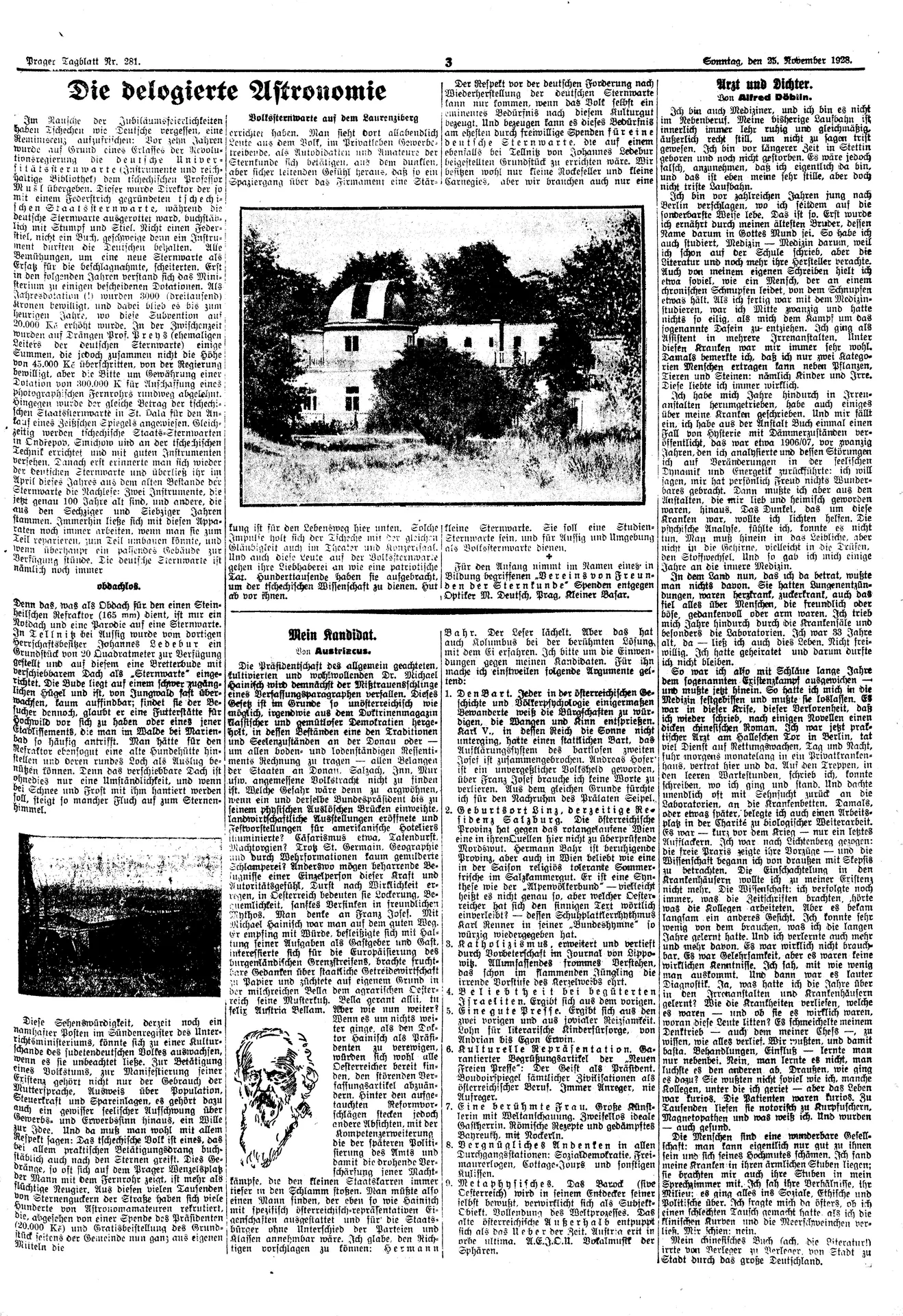
P1 - Rudolf Köhler: Die Sternwarte in Liesdorf-Tellnitz, Beiträge zur Heimatkunde des Aussig-Karbitzer Bezirkes, 1930, year 10, No 4, p. 145-149.
P2 - Annual reports: Vierteljahrsschrift der Astronomischen Gesellschaft, bundles 62-68 (reports published 1927- 1933).
P3 - Josef Mrázek: Zur Geschichte der deutschen Universitäts-Sternwarte in Prag und ihres Zweiges in Tellnitz, Die Himmelswelt 49, 1939, p. 2-6.
P4 - Österreichische Wehrzeitung, November 4, 1932, obituary Rudolf Tschilschke.
P5 - Vierteljahrsschrift der Astronomischen Gesellschaft 76 and 77, reports for the years 1940 and 1941.
P6 - Václav Slavík and Jaroslav Körner: There once was an observatory near Ústí..., Orion, 1979, year 19, No 2, p. 21-26.
P7 - Gedenkbuch Tellnitz, Teil I: Ein Observatory, record of provisional station from 1924.
P8 - Request of the Association of Friends of the Observatory for building permits and related building protocols, 1929.
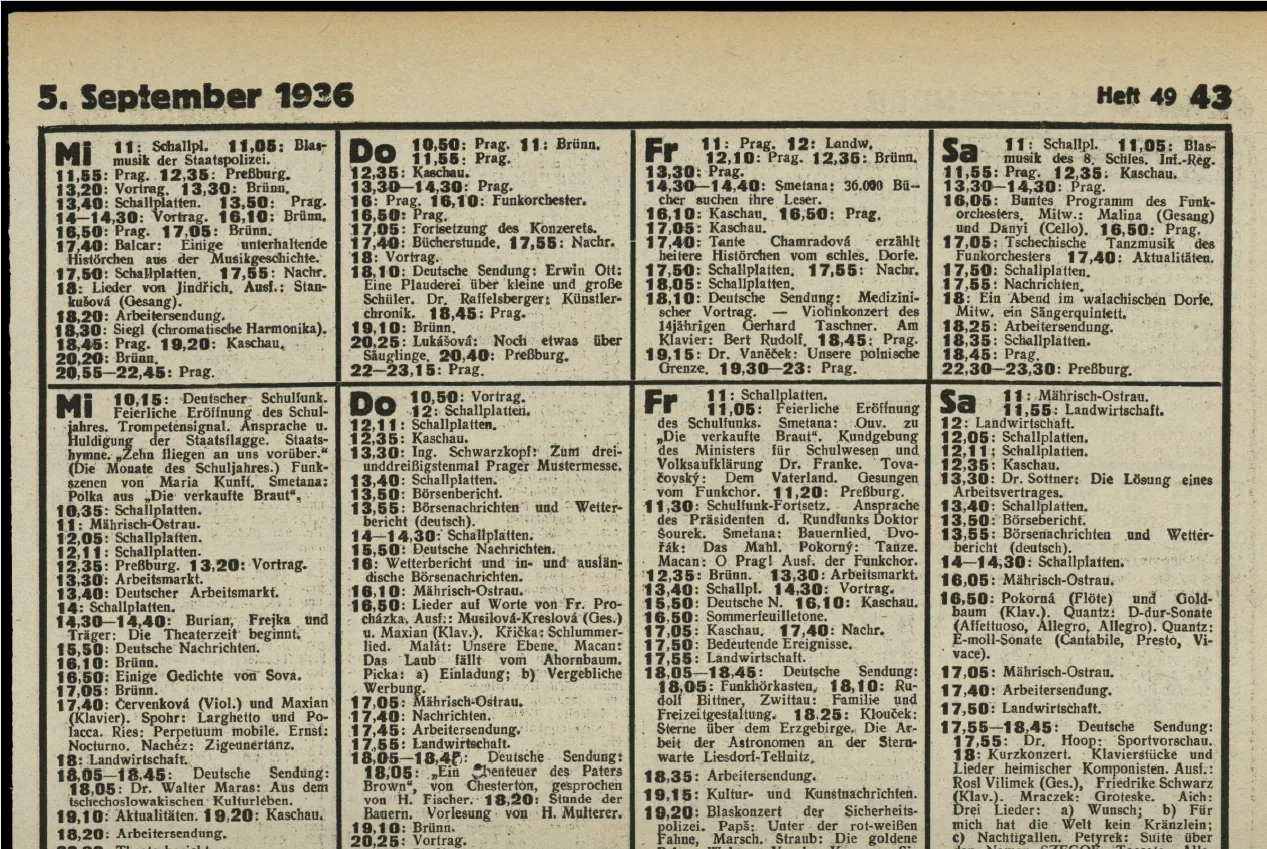
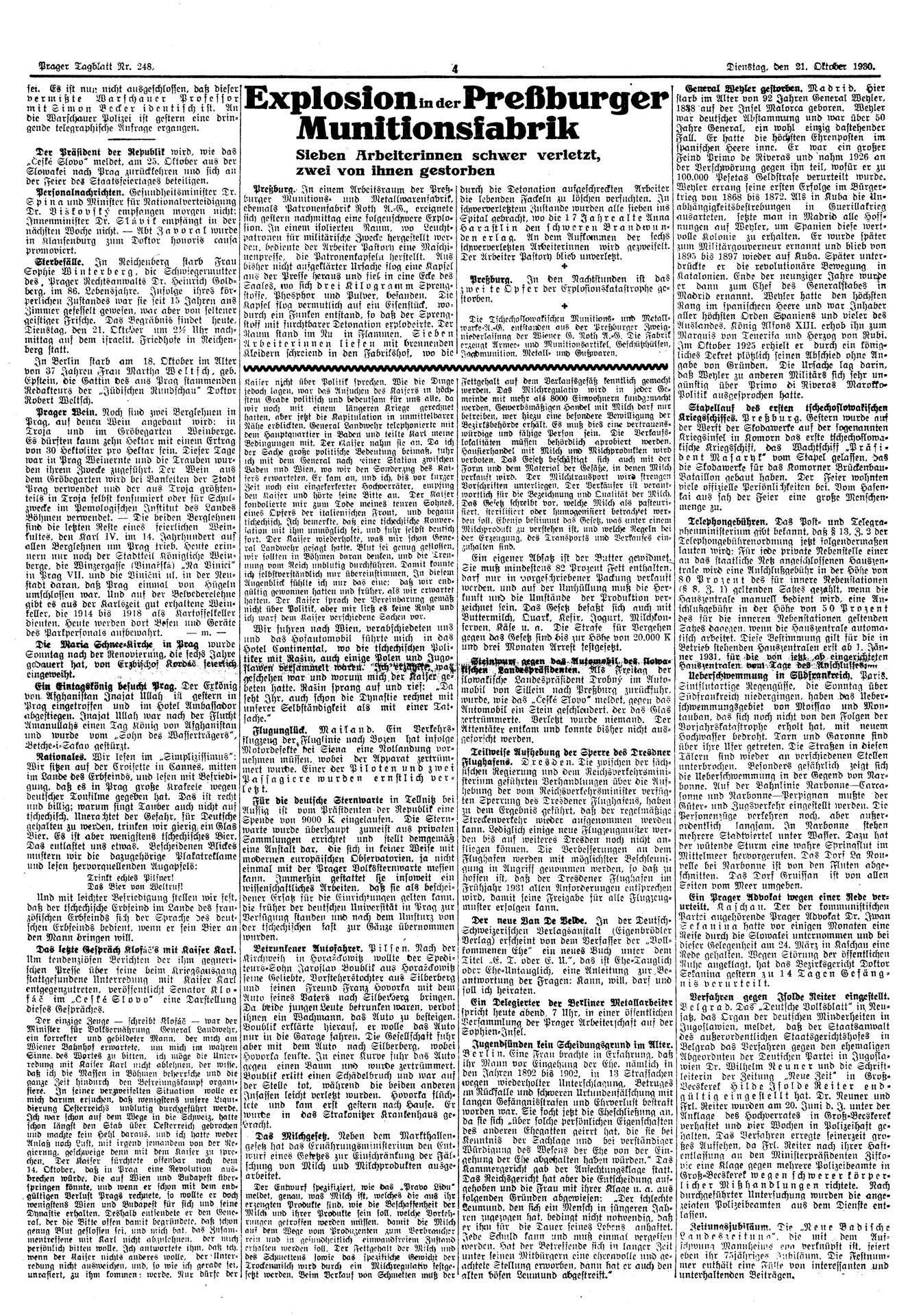
P9 - Radio Vienna, September 1936: programme "Sterne über dem Erzgebirge. Die Arbeit der Astronomen an der Sternwarte Liesdorf-Tellnitz '.
P10 - Astronomical yearbook / ephemerides for 1949, the Planets section and their satellites. The document is not an institutional chronicle of the observatory, but illustrates the period technical context and calculation tables with which astronomers worked.
Professional and secondary sources
S1 - Petra Hyklová: Astronomical research at Charles University in Prague from 1882 to present.
S2 - Petra Hyklová: Bachelor's work on dissertation and scientific focus of Astronomical Institute of German University in Prague.
S3 - Wikipedia: North Bohemian Observatory, status of the site analysed in July 2026.
S4 - Spacemanic: One weekend, two missions, report on the stratospheric mission of December 2024.
S5 - PRIM magazine 2 / 2024 and annual report of ELTON clock for 2024.
S6 - KODL / Artslimit Gallery: information about the PRIM TYCHO BRAHE KOSMOS benefit auction.
S7 - The materials of the owner and association Ústecká hvězdárna z. s. to the renewal, negotiations on land, building proceedings and petition provided for this chronicle.
Conclusion
The North Bohemian Observatory was not just a small stone building in the Ore Mountains. In the years 1924-1933 she was a real university measuring station where star photometry, precision astrometry and time service with meteorology, geomagnetism and solar radiation were connected. Its workers used specific, often historically valuable devices and created measuring lines with connection to Prague, Milešovka, Nauen and other observatory.
Her decline was not the result of a single decision. The staff losses, the economic crisis, the technical defects of old equipment, the plans of the new Prague Observatory, political twists, war and very practical problems with water, electricity and winter availability have been combined. After the war, the science station turned into a recreational object, lost its instruments and eventually an above-ground building.
The recovery started in 2022 therefore does not return life to mere ruin. It follows a specific scientific program, the work of Josef and Marie Mrázková, Rudolf Tschilschke and their collaborators and a unique technical heritage. The PRIM project has shown that the new story of the observatory can combine historical memory, contemporary technology, public support and a renewed desire to observe and measure.